There are exhibitions that simply open. And then there are exhibitions that quietly shift the axis of cultural memory.
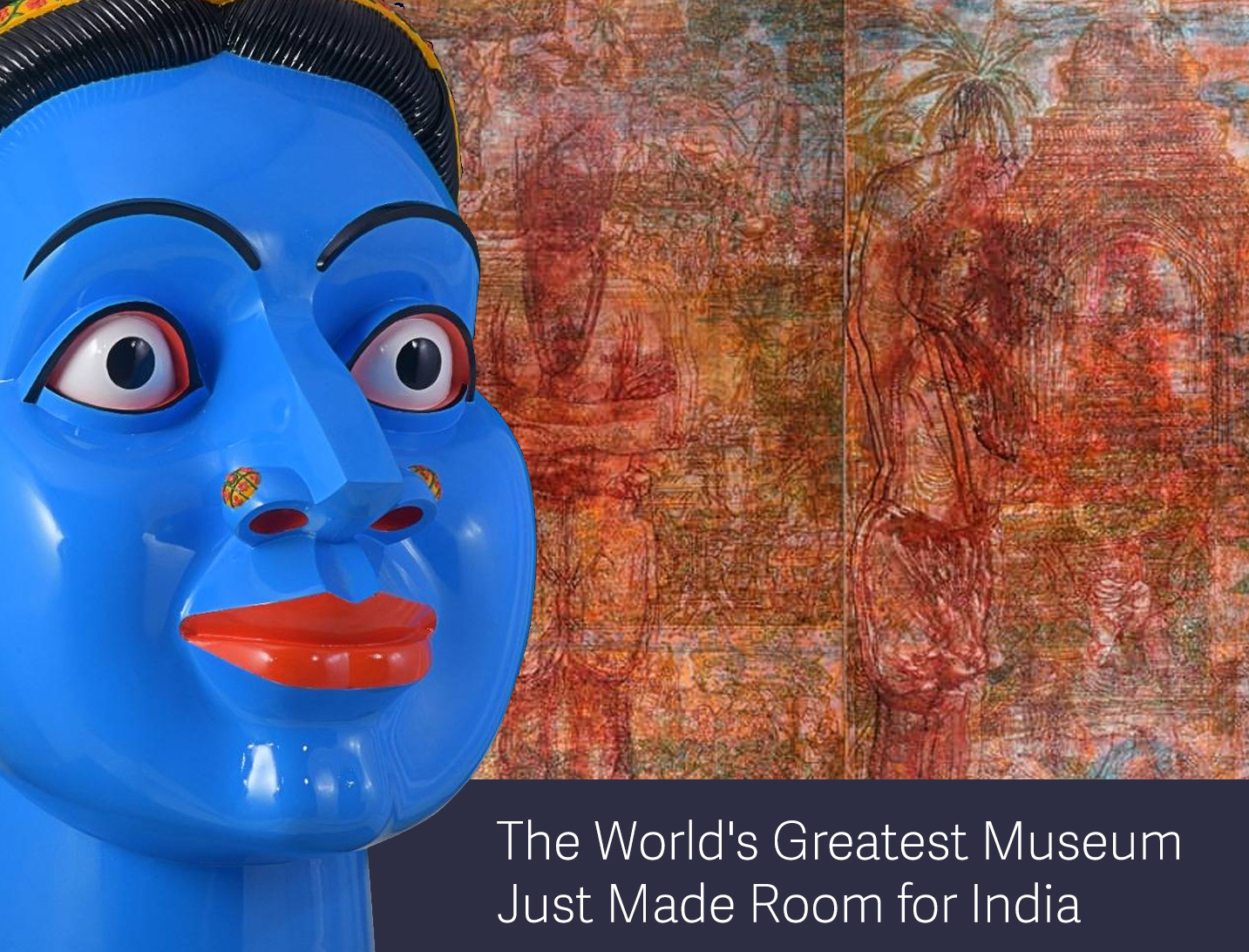
On June 4, 2026, one such moment will unfold in St. Petersburg, Russia, as the State Hermitage Museum hosts “Sediments of Becoming: Fossilised Present, Summoned Pasts” its first dedicated exhibition of contemporary Indian art in the institution’s 260-year history.
For India’s art world, this is not merely another international showcase. It is a significant act of cultural arrival.
The Hermitage is not just a museum. It is one of the great repositories of world civilisation, a place where empires, aesthetics, histories, conquests, curiosities and cultural exchanges have been preserved, arranged, studied and displayed for generations. To bring contemporary Indian art into such a space is to allow India to speak not as an ancient subject, not as a colonial archive, not as an exotic footnote, but as a living, questioning, evolving civilisation.
Curated by Marina Schulz, Head of the Contemporary Art Department at the State Hermitage Museum, and Tuntila “Tunty” Chauhan, founder of Threshold Art Gallery, New Delhi, the exhibition brings together works by 11 contemporary Indian artists: Manjunath Kamath, Afrah Shafiq, Gargi Raina, Lakshmi Madhavan, V. Ramesh, Anindita Bhattacharya, Debashish Mukherjee, Maya Krishna Rao, Pushpamala N., Ravinder Reddy and Sumakshi Singh.
What makes the exhibition especially compelling is its conceptual ambition. It does not treat contemporary art as a decorative addition to a historic museum. Instead, it positions artistic practice as a form of cultural archaeology, a way of digging through time, memory, identity and inherited narratives.
The title itself, “Sediments of Becoming,” suggests layers: what has settled, what has survived, what has been buried, and what continues to rise. In the Indian context, this becomes deeply resonant. India is not a single linear story. It is a layered civilisational terrain — full of rituals, ruptures, migrations, mythologies, wounds, philosophies, folk memories and contemporary urgencies. The artists in this exhibition appear to approach that terrain not with nostalgia, but with inquiry.
The exhibition also places contemporary works in dialogue with historic objects including icons, frescoes, graphic prints and decorative arts drawn from the collections of the Hermitage and other Russian institutions. This dialogue between past and present is important.
It reminds us that history is not something locked behind glass. It continues to breathe through the artist’s hand, through material, through form, through performance, through resistance and through reinterpretation.
For decades, Indian art has often been seen through frameworks created elsewhere, collected, classified, interpreted and displayed through external eyes. This exhibition offers a different proposition. It presents Indian artists as authors of their own civilisational complexity. They are not illustrating India for the world. They are thinking through India, from within India, while speaking to the world.
That distinction matters.
In a time when global politics often hardens borders, art continues to move across them with a different kind of intelligence. It does not erase conflict, but it creates spaces where cultures can encounter each other without reducing one another. In that sense, this exhibition is not only about Indian art in Russia. It is about the possibility of dialogue at a time when dialogue itself feels fragile.
Threshold Art Gallery’s role in enabling this moment is also significant. The collaboration suggests how private galleries, curators, collectors and public institutions can work together to create cultural bridges that are both intellectually rigorous and emotionally meaningful. The artists were invited to create new works for the exhibition, some responding to the curatorial framework, others shaped by their engagement with the Hermitage collections during a 2025 residency.
This gives the exhibition a rare depth. It is not a travelling display placed inside a prestigious venue. It is a site-responsive conversation — one in which contemporary Indian artists are engaging with one of the world’s most historic museum collections and, through that encounter, opening new meanings.
The presence of artists such as Pushpamala N., Ravinder Reddy, V. Ramesh, Sumakshi Singh and others also reflects the range of contemporary Indian practice today. From sculpture and photography to textile, performance, installation and mixed media, the exhibition points to a country whose artistic language cannot be contained within one style or school. It is plural, restless and conceptually alive.
At its heart, “Sediments of Becoming” asks a powerful question: who gets to interpret history?
For India, this question is never neutral. Our past has often been narrated by rulers, colonisers, institutions and outsiders. But contemporary artists complicate that inheritance. They disturb the settled layer. They re-enter the archive. They make memory unstable again. They allow the past to be not only remembered, but reimagined.
That is why this exhibition matters.
It is not simply a proud moment for the participating artists. It is a larger moment for Indian cultural confidence. It places contemporary Indian art in one of the world’s most respected museum spaces and insists that India’s present is as intellectually rich as its past.
The exhibition will remain on view at the State Hermitage Museum until October 4, 2026.
For the global art audience, it offers a rare encounter with the depth, tension and beauty of contemporary Indian thought.
For India, it is something more intimate.
It is a reminder that our stories are still becoming. And this time, we are telling them ourselves.
Leave a Reply