
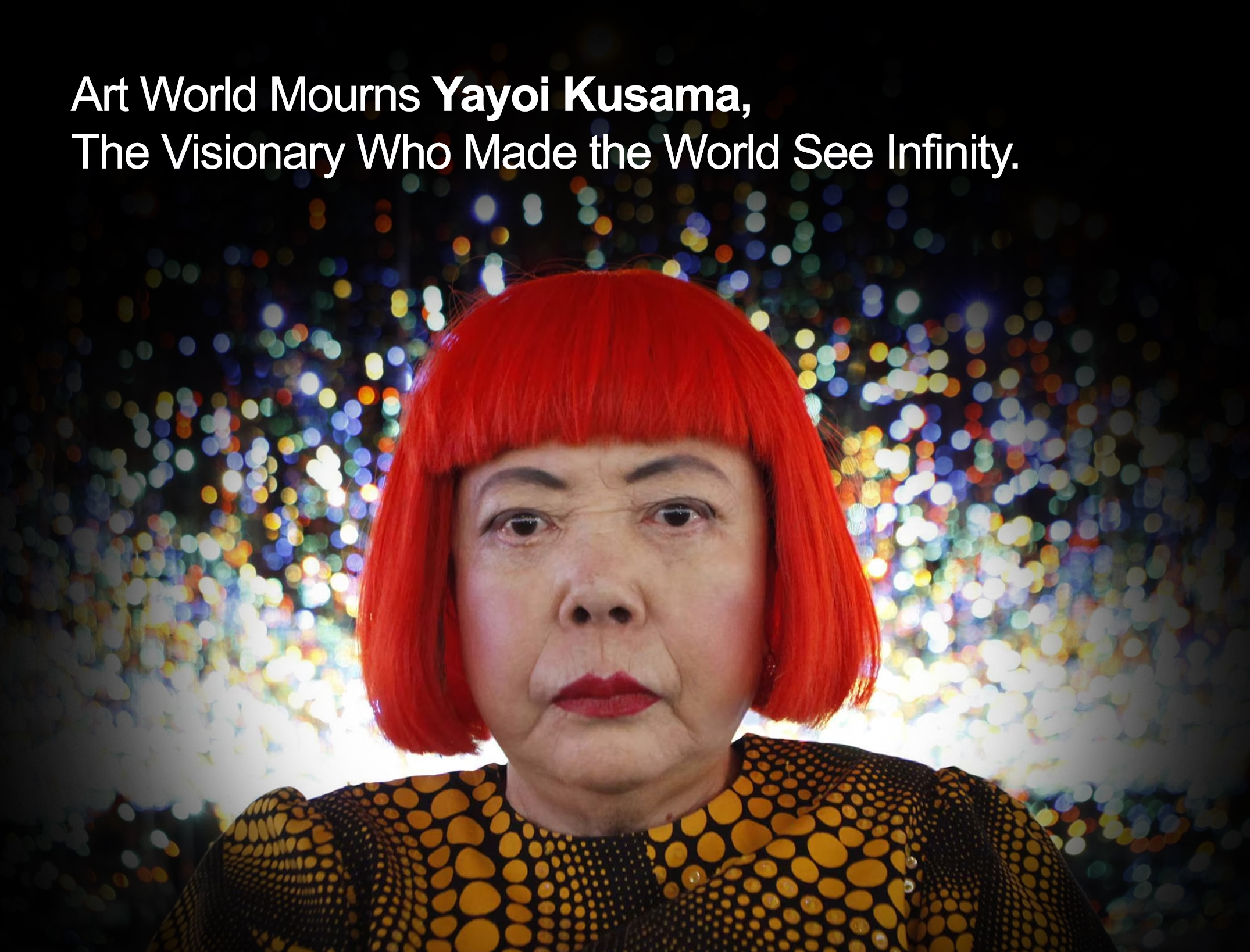
The world of contemporary art has lost its brightest, most eccentric, and unyielding star. Yayoi Kusama, the trailblazing Japanese avant-garde artist whose signature polka dots, kaleidoscopic “Infinity Mirror Rooms,” and vibrant pumpkins captivated millions across continents, passed away peacefully in a Tokyo hospital on August 14, 2026. She was 97 years old.
Announced officially on August 26 by her studio, Yayoi Kusama Inc., the news marks the end of an unparalleled creative odyssey that spanned over seven decades. In a heartfelt statement, her team confirmed that Kusama lived as she painted—relentlessly: “She continued to paint until her final days, never setting aside her brush, and continued exploration of forever love and eternal soul.”
A Sanctuary Built from Hallucinations
Long before she became the world’s most Instagrammed artist—with millions of museum-goers queuing for hours just to catch a fleeting 30-second glimpse into her mirrored sanctuaries—Kusama’s art was born out of profound psychological necessity.
Born in Matsumoto, Nagano Prefecture, in 1929, Kusama endured a turbulent childhood marked by a stern mother and a fractured domestic environment. At just ten years old, she began experiencing vivid visual and auditory hallucinations. Fields of flowers would suddenly start talking to her, and red tablecloth patterns would creep across the floor, scaling the walls, ceiling, and her own skin.
Where others saw terrifying illness, Kusama found her medium. She picked up a sketchbook, recording her hallucinations with obsessive precision. Painting became her mechanism for survival, an act of what she termed “self-obliteration”—dissolving her personal identity into the boundless rhythm of the universe so that the madness could no longer consume her.
“I was looking at the red flower patterns of the tablecloth on a table, and when I looked up I saw the same pattern covering the ceiling, the windows and the walls… I felt as if I had begun to self-obliterate, to revolve in the infinity of endless time and the absoluteness of space, and be reduced to nothingness.”
— Yayoi Kusama
Conquering New York and Reclaiming the Avant-Garde
Refusing an arranged marriage and turning her back on traditional Japanese Nihonga painting, Kusama boarded a plane for New York City in 1958 with a few hundred dollars sewn into her dress lining and a bundle of drawings.
In the hyper-masculine, white-dominated art scene of 1960s Manhattan, Kusama was a double outsider: an Asian woman forging her own radical path. Yet, her breakthrough was swift and undeniable. Her monochrome “Infinity Nets”—enormous canvases dense with tens of thousands of tiny, repeating brushstrokes—redefined minimalist painting.
She expanded into soft sculptures—covering furniture with fabric-stuffed phallic forms to confront and conquer her deep-seated anxieties and staged explosive, anti-war “happenings.” She painted polka dots on unclothed protest art groups, crashed the 1966 Venice Biennale with her guerilla installation Narcissus Garden (selling reflective glass balls for $2 a piece until organizers shut her down), and even wrote an open letter to President Nixon offering to sleep with him if he ended the Vietnam War.
Despite her groundbreaking work, the mainstream art establishment often marginalized her, leaving male peers like Andy Warhol and Claes Oldenburg to reap commercial rewards for concepts Kusama had pioneered.
The Sanctuary Studio and the Great Revival
Exhausted by intense work habits, financial strain, and severe depression following the death of her close companion, artist Joseph Cornell, Kusama returned to Japan in the 1970s. In 1977, demonstrating extraordinary self-awareness, she voluntarily checked herself into the Seiwa Hospital for the Mentally Ill in Tokyo.
Far from stepping back, the hospital became her sanctuary. For nearly 50 years, Kusama lived as a permanent resident at Seiwa, walking across the street every single morning to her private studio to paint, write poetry, and craft novels from dawn until dusk.
The art world eventually caught up with her genius. A triumphant presentation at the 1993 Venice Biennale reignited global interest, sparking major retrospectives at the Tate Modern, MoMA, and the Whitney. In 2014, her canvas White No. 28 sold at auction for $7.1 million, setting a record for a living female artist.
The Queen of the Immersive Era
In the 21st century, Kusama achieved a rare, mythic cultural stature. Her multi-sensory Infinity Mirror Rooms—dazzling installations of endless LED lights, mirrors, and polka-dotted yellow pumpkins—became global blockbuster phenomena. From Tokyo and London to Washington and Melbourne, record-breaking crowds lined up to experience a moment of transcendent stillness within her cosmic spaces.
Yet, despite the pop-culture frenzy, Kusama remained profoundly indifferent to commercial hype or elite consensus. Dressed in her signature neon wigs and dot-printed smocks, she remained single-mindedly devoted to her canvas and her message of universal love, peace, and spiritual infinity.
As global cultural community bid farewell to a titan, Yayoi Kusama leaves behind more than just iconic yellow pumpkins and polka dots. She leaves a testament to how human suffering, when transformed by relentless creative courage, can light up the entire universe.
“I cannot imagine how I will be classified after my death. It feels good to be an outsider.”
— Yayoi Kusama
Leave a Reply