
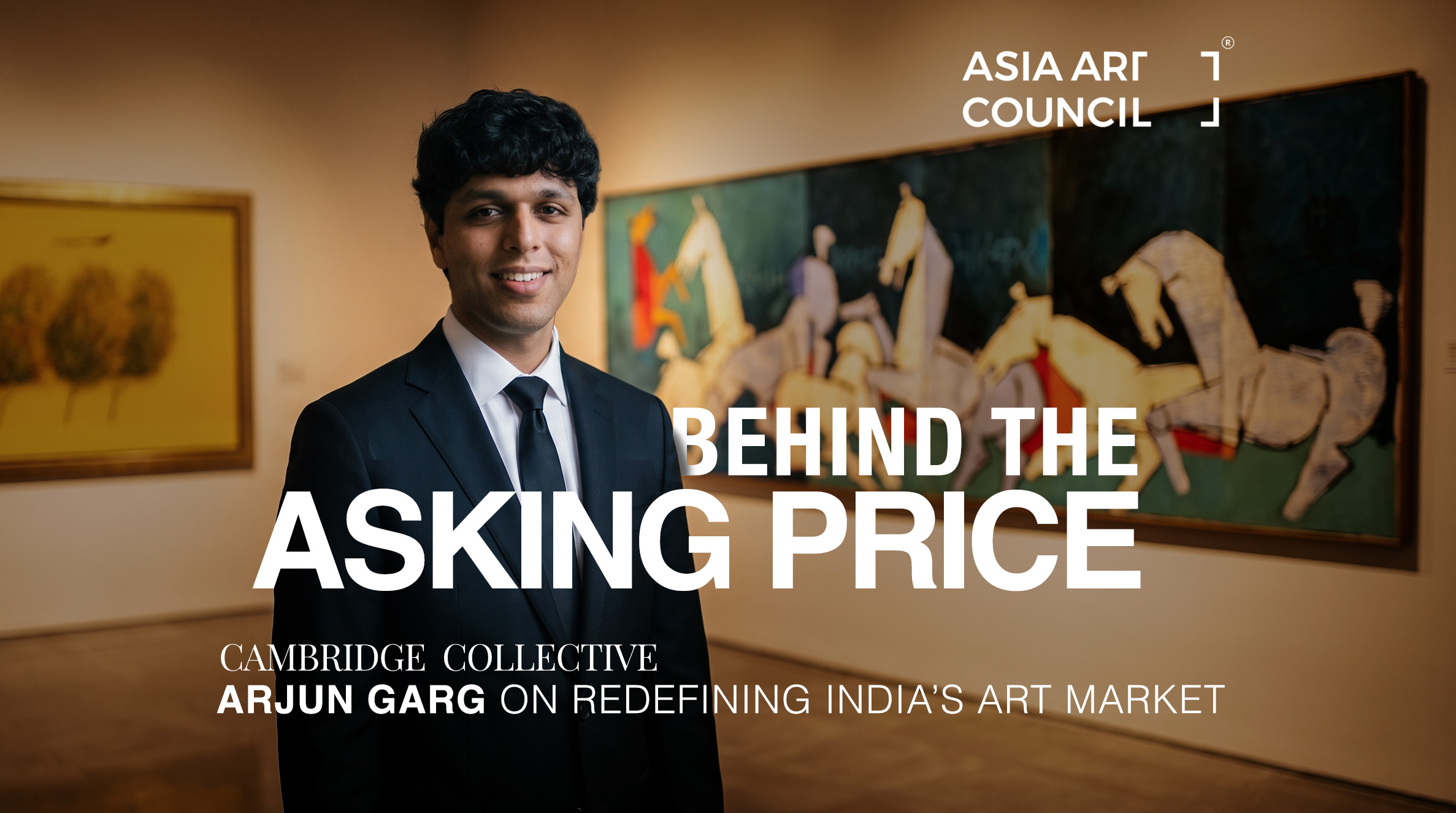
Asia Art Council speaks with Arjun Garg, founding member of Cambridge Collective, a Harvard-incubated art advisory firm.
Drawing on his experience in finance and his personal relationship with art, Garg discusses the need for greater price transparency, stronger diligence and a more collector-centered art market.
Asia Art Council (AAC): Can you tell us about your background and how you first entered the art world?
Arjun: I originally wanted to become an investment banker. I was drawn to finance because I enjoyed understanding value and how assets move through markets.
My exposure to private equity and real estate deepened my interest in alternatives.
Art occupied a completely different place in my life. It was never an asset class. It was my escape into ideas that numbers, and sometimes words, could not capture.
A painting could slow me down, transport me, and reveal something new each time I returned to it.
I never considered its business side until my now colleague, Raman Solanki, and I began discussing private sales. During a Cy Twombly exhibition at the MFA Boston, he showed me the same Picasso being offered for $10 million and $25 million through different sources. That moment made the market’s opacity impossible to ignore.
My finance background helped me understand the problem, but my love for art gave me a reason to solve it. I wanted to bring transparency, diligence, and fairness to collecting so people could acquire art with confidence without losing the wonder that drew them to it. For me, this work is about protecting trust, honoring artistic legacies, and helping exceptional works find homes where they will continue to matter.
AAC: What kinds of artists and works do you advise collectors on?
Arjun: We began with a strong focus on Western art, primarily across Impressionism, Modern and Postwar art. This has included works by artists such as Pablo Picasso, Andy Warhol, Claude Monet, Pierre-Auguste Renoir, and Jackson Pollock.
At the same time, as an Indian, I have always felt a natural pull toward Indian art and wanted to see it recognized internationally with the same seriousness as Western art. Today, a significant part of our work focuses on Indian Modern Masters such as M.F. Husain, S.H. Raza, F.N. Souza, Tyeb Mehta, Manjit Bawa, and Ram Kumar. I connect deeply with these artists because their work captures a nation in the act of becoming, negotiating tradition and modernity while defining itself on its own terms. Together, they created visual languages powerful enough to stand anywhere in the world.
With that said, every collector is different. We do not begin with a predetermined list of artists and try to fit the collector into it. We begin with the person: the purpose of their collection, the stories that resonate with them, and the relationship they hope to build with their art. Our role is to understand that vision and help them find works that give it meaning.
AAC: What are the most urgent problems facing the art market today?
Arjun: In my view, the greatest problem in the art market is price opacity. A buyer may not know who is representing whom, whether a dealer is acting for the buyer or the seller, how that dealer is being compensated, how many intermediaries are involved, what the seller actually expects to receive, or how the final price was constructed.
This lack of disclosure is sometimes defended as a matter of privacy. Collectors have legitimate reasons for keeping their identities confidential, but privacy should not obscure the economics of a transaction. Buyers are providing the capital, and they deserve to understand exactly what they are paying for. This becomes particularly concerning when undisclosed markups are extreme. In one case involving a work by Thota Vaikuntam, we encountered an undisclosed markup of approximately 200%.
The result is an intimidating environment for new collectors. They may love art and have the means to participate, but they do not feel safe transacting.
AAC: What would a more transparent and disciplined art market look like?
Arjun: At Cambridge Collective, we have created a small version of the market we hope to see. Because collectors trust our model, market participants who work with us adapt to its rigorous standards. That trust also gives us a responsibility to filter works, challenge pricing, and scrutinize every detail before anything reaches the collector.
We represent only the collector in an acquisition, so our incentives are clear, and every recommendation is made in their best interests. They know how many intermediaries are involved, what the seller expects, and how everyone is compensated. We apply financial rigor to every opportunity by studying comparable sales, evaluating the factors that influence value, and determining whether the asking price is justified. We also verify the documentation in advance.
A collector should never be asked to fall in love with a work based on incomplete information. This is both our vision for the market and the protocol we follow ourselves.
AAC: Can you walk us through how you help a collector, from the first conversation to an acquisition?
Arjun: We begin with the collector. They may be buying their first serious work, developing an existing collection, or searching for a specific piece.
We learn what resonates with them, their budget, and what they want their collection to represent.
From there, we source through multiple credible channels, compare opportunities, and identify the most direct and transparent route to the owner.
We conduct a comparables analysis and coordinate with specialists on condition, provenance, and authenticity.
When we present a work, the collector sees the owner’s asking price, our fee, and our market analysis. Our role is to give them the clarity and confidence to make an informed decision.
AAC: Is there an artist or artwork that holds special significance for you?
Arjun: Jackson Pollock is the artist who moves me most. When I stand before one of his paintings, I feel pulled into it.
My eyes follow one line until it disappears, then find another, and eventually I stop trying to understand the composition. I simply surrender to it. It makes me feel free.
That feeling becomes even more powerful when I think about what his work came to represent. During the Cold War, Pollock’s Cathedral was displayed at the American National Exhibition in Moscow. At a time when Soviet artists were expected to work within a state-approved style, people encountered a painting with no instructions and no single meaning. They were free to experience and interpret it for themselves. That history makes my own appreciation for Pollock feel part of something larger. To me, that is his power: he does not tell you what to feel. He creates the space for you to feel something entirely your own.
AAC: How do you see the role of an art advisor changing as a new generation of collectors enters the market?
Arjun: The advisor’s role is expanding because a new generation of collectors has different expectations. Contemporary buyers often want a connection to the artist and their story, while buyers of established masters require rigorous guidance on long-term value.
What both groups expect is education, access, and transparency. They are accustomed to professional standards in other industries and will not accept mystery as a substitute for information. The advisor of the future must combine judgment, research, and market analysis while remaining a trusted representative of the collector.
AAC: How do you stay inspired?
Arjun: There is a painting at the Harvard Art Museums that I return to almost every week: Claude Monet’s Red Boats, Argenteuil. Each visit reveals something different. Some days, the clouds draw my attention. On others, it is the reflection on the water or the green in the leaves. What remains constant is how the painting makes me feel safe and grounded, as though I could step inside it.
That experience reminds me why I do this. Art is not simply an object of beauty or an asset. It is an object of love. I want to help collectors find works that create that same sense of peace, where the connection deepens each time they look until the work becomes part of how they understand themselves.
Leave a Reply