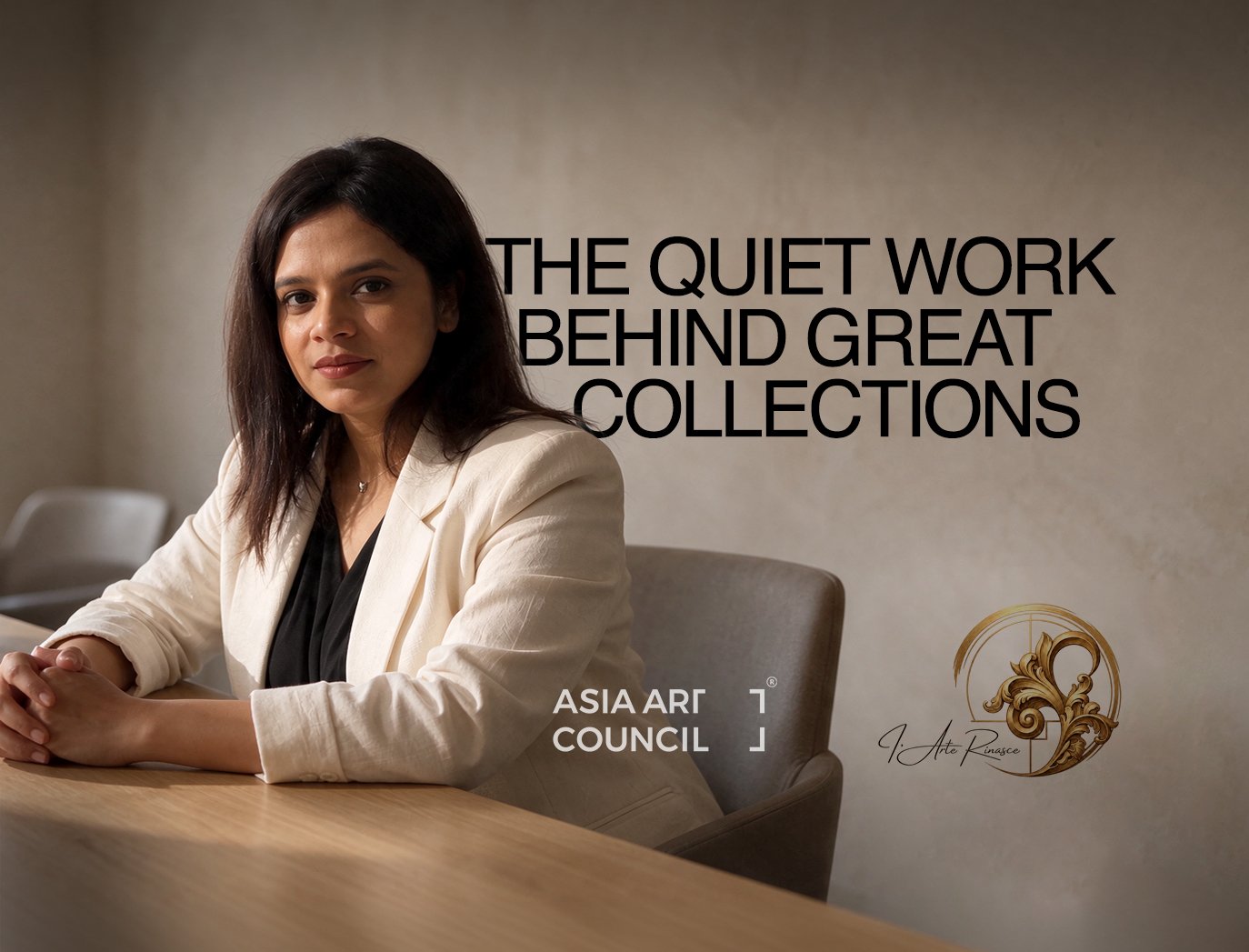
Aishwarya Chandurkar on Art Advisory and Integrity.
Aishwarya Chandurkar is a Florence-trained fine art conservator from LDM with a decade of experience, and the founder of I’Arte Rinasce, a conservation, advisory and curated sales practice working across Mumbai and Auckland. She spent eight years leading the conservation department at a premium auction house in Mumbai before establishing her own practice, and works at the meeting point of scholarship, material care and the art market. She is currently researching a book on how inherited art and its histories are understood, documented and preserved, alongside a study of neuroaesthetics and restoration, which she expects to complete in 2027
AAC: Tell us a bit about your journey. What is your background, what’s your primary area of expertise, and what excites you most about what you’re working on right now?
Aishwarya : I trained as a conservator in Florence, where conservation is taught less as a technical service than as a way of thinking about time. You learn early that every intervention is a decision made on behalf of people who will look at the work long after you. I then spent eight years in Mumbai leading the conservation department at an auction house, caring for modern and contemporary Indian paintings as they moved between collections and through the market.
That vantage point shaped what I am building now. Again and again I saw that a work’s physical condition, its documentation and its commercial life were treated as separate conversations in art market, held by people who rarely spoke to one another. I founded I’Arte Rinasce to bring those conversations together: conservation and collection care, art advisory, and curated sales for a small group of artists, all under one philosophy of custodianship. We think of ourselves less as a gallery than as a long-term custodian of the works that pass through our hands.
What excites me most at the moment is documentation, and specifically how we record and pass on everything an artwork carries with it: its materials, its history of care, its provenance, and the stories of the families who lived with it. I am researching a book on inherited art, and developing an approach I call Artwork Intelligence. It brings art-historical research, provenance, conservation records and scientific examination into a single, coherent record, with technology supporting expert judgement rather than replacing it.
Alongside this, I am researching the meeting point of neuroscience and restoration: how the brain perceives a painting, and how damage, discoloured varnish or a visible repair changes that experience. I expect to complete this research in 2027. My hope is that it will give us a way of understanding the value of an artwork that goes beyond its market price, grounded in what a work actually does to the person standing in front of it.
AAC: Looking at the art and design scene in Asia today, how would you describe its current energy and momentum? What big shifts have you noticed over the last few years from where you stand?
Aishwarya: The energy is real, and more importantly it is broadening. A few years ago the conversation was concentrated in a handful of cities and a handful of names. Today there are more fairs, art weeks, private museums and foundations across the region, and more collectors who see Asian art not as a regional category but simply as art.
From where I stand, at the conservator’s bench, three shifts stand out. The first is inheritance. Many significant private collections in India were assembled one or two generations ago and are now passing to heirs, who ask different questions about what they own, what it needs and what it means. The second is that scholarship is slowly catching up with the market, through estates, archives and serious research projects, although there is still a long way to go. The third is quieter but important to me: more collectors now ask about condition and documentation before they ask about price. It is not yet the norm, but it is a genuine change in maturity.
AAC: What do you feel are the biggest bottlenecks or challenges holding the Asian art ecosystem back right now, and how do we solve them?
Aishwarya : The first is trust. For many important artists in the region there is no complete catalogue raisonné, provenance records are thin, and doubtful attributions circulate. When buyers cannot verify what they are buying, value becomes fragile for everyone, including the artists. The solution is unglamorous: consistent, independent condition and provenance records that travel with a work from one owner to the next, and examination before sale rather than after a dispute.
The second is care. There are far too few trained conservators relative to the number of works in private hands, and climate makes this urgent. Monsoon humidity, heat and air-conditioning that runs only part of the day do real damage to canvases and works on paper. Most care in the region is still reactive: a work is treated only once something has visibly gone wrong. We need training pathways for conservators, and far more preventive education for the people who live with art.
The third is fragmentation, and it falls hardest on living artists who are still establishing themselves: emerging and mid-career contemporary artists, many of whom work in the lineage of the great names but are not yet widely known. They are often unsupported between exhibitions, the terms offered to them are not always transparent, and their careers can be shaped more by the market than by their own practice.
We are doing well by our modern masters. Their works are researched, conserved, exhibited and valued. But we risk forgetting that the artists working today may be the masters of fifty or seventy years from now. If we do not document their practice, record their materials, care for their works and give them fair, long-term support now, we will be trying to reconstruct their histories later, as we so often do for the modernists. Thinking about the future of Asian art means investing in its living artists today.
AAC: If you had a magic wand to reshape the industry, what concrete steps or bold strategies should we take to make art more accessible, financially viable, and sustainable for everyone involved?
Aishwarya : I would begin with a simple standard: every significant work sold in the region should be accompanied by a condition report and a provenance file, much as a property comes with its title documents. It protects buyers, gives artists’ markets a firmer footing, and costs very little relative to the value it secures.
Second, I would invest in people: fellowships for young conservators, shared regional conservation facilities, and partnerships between institutions and private practices so that skills are not concentrated in a few cities.
Third, I would make the economics fairer for artists. That means artist-majority consignment terms, transparent pricing that does not undercut an artist’s own market, and respect for resale rights where they exist in law, as they do in India, but are rarely honoured in practice.
Accessibility and sustainability, to my mind, follow from the same principle. Help people understand what they are looking at, and help them care for what they already own. Preventive conservation is the most sustainable thing our field can offer: a well-kept work needs less intervention, less material and less risk over its lifetime.
Finally, I would widen the definition of value itself. Today the market price speaks loudest. But a work’s value also lies in its capacity to move people, to hold attention and to carry memory, and neuroscience is beginning to give us language for this. If we can describe that value with some rigour, we strengthen the case for caring for works that the market overlooks.
AAC: What role do you think we all play, whether as collectors, advisors, galleries, or institutions, in actively nurturing and growing the Asian art community?
Aishwarya : Each of us holds a different part of the same responsibility. Collectors are custodians for a period of time, not merely owners. Caring for works properly, documenting them and lending them so they can be seen is a genuine contribution to culture. Advisors owe their clients honesty, which sometimes means advising against a purchase. Galleries can invest in artists beyond the life of a single show, with clear and fair terms. Institutions can open their archives and their expertise, and help train the next generation of specialists.
For conservators, I think the responsibility is to step out of the back room. Much of what we know about materials, condition and care is precisely what collectors and artists need, and sharing it openly makes the whole ecosystem more resilient.
AAC: How are you seeing younger buyers approach art differently compared to the traditional collector base?
Aishwarya : Younger collectors arrive better informed and less deferential. They research online, follow artists directly, and care about an artist’s practice and values as much as about the name on the canvas. They are more open to emerging artists, works on paper, photography and design, and they tend to buy work to live with rather than to store.
What I sometimes see missing is attention to the object itself: its condition, its materials and its paperwork. That is not a criticism; it is an opportunity. When a younger collector understands why a work was made the way it was and how to look after it, the relationship with the piece deepens, and so does their confidence as a collector.
AAC: What keeps you grounded, and where do you look for inspiration when you need to recharge?
Aishwarya : The work itself. Conservation is slow by nature. Spending hours with a single painting, following each crack and brushstroke, is an extraordinary discipline in a world that moves so quickly. It reminds me that the artwork sets the pace, not the market.
For inspiration I return to art history and, increasingly, to neuroaesthetics: the question of why and how we respond to images at all. It has changed how I work at the bench. When I retouch a loss now, I think not only about the paint but about the million eyes and the brain that will meet it somewhere in its future. And I return, at least in memory, to Florence, where I first understood that caring for a work of art is itself a form of scholarship.
AAC: You are researching neuroscience and restoration. Where do the two meet?
Aishwarya : More closely than most people expect. Restoration has always been about perception. When a painting has losses, a yellowed varnish or old, discoloured repairs, the viewer’s eye is pulled to the damage and the image loses its coherence. Conservation theory has long described this; Cesare Brandi wrote in 1963 of restoring a work’s “potential unity”. Neuroaesthetics now lets us ask how this happens in the brain: what the visual system does with a gap, why some retouching disappears while other retouching keeps drawing attention, and how the emotional response to a work changes once it has been cleaned.
My research brings these two fields together, and I expect to complete it in 2027. Practically, it can inform how conservators make decisions, such as how much to reintegrate, how visible a repair should be, and when to leave a work alone. More broadly, I hope it will change the way we look at art, giving us a language for its value that sits alongside, and is not dictated by, its market price.
AAC: What advice would you give someone beginning a collection?
Aishwarya : Buy slowly, look often, and ask questions that have nothing to do with price: who made this, how was it made, where has it been, and what will it need from me?
Keep every document. Above all, buy what you are prepared to look after.
Leave a Reply