
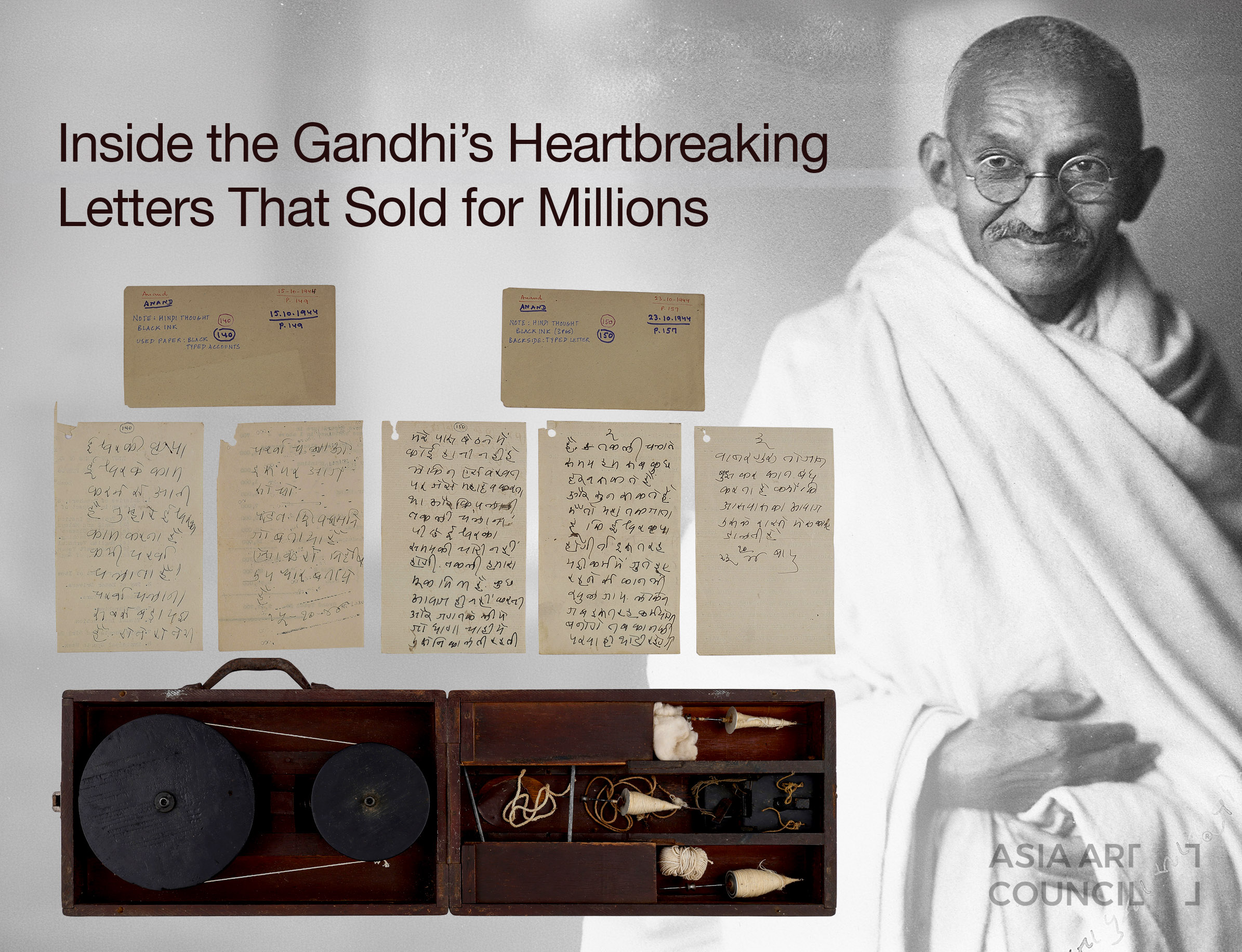
A Record-Breaking Auction Redefines the Value of Indian Historical Documents.
The antiquities and historical manuscript market in Asia reached a watershed moment this August when an unprecedented archive of handwritten reflections by Mahatma Gandhi shattered expectations in Mumbai. Selling for a staggering Rs 16.20 crore (approximately $1.7 million), the manuscript set a world auction record for an Indian historical document.
This monumental sale, hosted by the Mumbai-based auction house saffron art, invites a critical re-evaluation of how we appraise historical archives. We view this not merely as a transaction, but as a testament to the profound market gravitation toward emotionally resonant, deeply personal historical artifacts.
Provenance and Emotional Weight
The collection, ultimately compiled into the book A Thought for the Day, comprises 688 dated reflections authored by Gandhi over 23 months. However, the astronomical valuation of Lot 80 stems from its intensely personal provenance. These notes were not drafted for public consumption; they were written as an act of compassion.
Gandhi dedicated time daily between 1944 and 1946 to write to his close associate, Anand T. Hingorani, to console him following the tragic loss of his wife, Vidya. Hingorani, who marched with Gandhi at Dandi and served time during the Civil Disobedience movement, preserved this archive across generations.
The manuscript covers grand philosophical themes of ahimsa (non-violence), brahmacharya, truth, and religious equality, yet it was fundamentally anchored in guiding a grieving friend. From a curatorial perspective, this dual nature—the monumental and the intimate is what drives elite collectors to bid aggressively. It bridges the gap between Gandhi the global icon and Gandhi the empathetic mentor.
A Broader Shift in the Auction Market
The “Gandhi: From the Collection of Anand T Hingorani” 86-lot auction demonstrated that the Asian antiquities market is maturing rapidly, expanding its definition of “art” to encompass documentary heritage.
The buyer of the premier Rs 16.20 crore lot remains anonymous but is confirmed to be based in India, ensuring this irreplaceable artifact stays within the country.
Other lots in the Saffronart auction similarly commanded premium prices:
- “Message on God”:A trio of manuscripts concerning Gandhi’s reflections on the Bhagavad Gita sold for Rs 1.68 crore.
- The Peti Charkha:A box spinning wheel accompanied by letters on the discipline of spinning realized Rs 1.02 crore.
- Photographic Archives:A signed presentation photograph of the Mahatma writing fetched Rs 78 lakh.
These figures are highly indicative of current market trends. While classical paintings and sculptures have traditionally dominated blue-chip auctions in India, there is a burgeoning appetite for tangible pieces of national history. Saffronart Co-founder Dinesh Vazirani aptly noted that the sale reinforces the historical rarity of seeing such a significant figure through the lens of a personal relationship.
The Future of Historical Collectibles
For the Asia market & collectors globally, the Hingorani archive auction is a definitive benchmark. It proves that institutional and private buyers are willing to invest heavily in items that offer a direct, tactile connection to the foundational figures of the 20th century. The Rs 16.2 crore valuation is not merely the price of paper and ink; it is the market’s quantification of unmediated access to the mind of Mahatma Gandhi.
As we look ahead, we can expect auction houses across Asia to increasingly spotlight historical archives and private correspondence, elevating them to the same prestigious platforms traditionally reserved for fine art.
Leave a Reply