
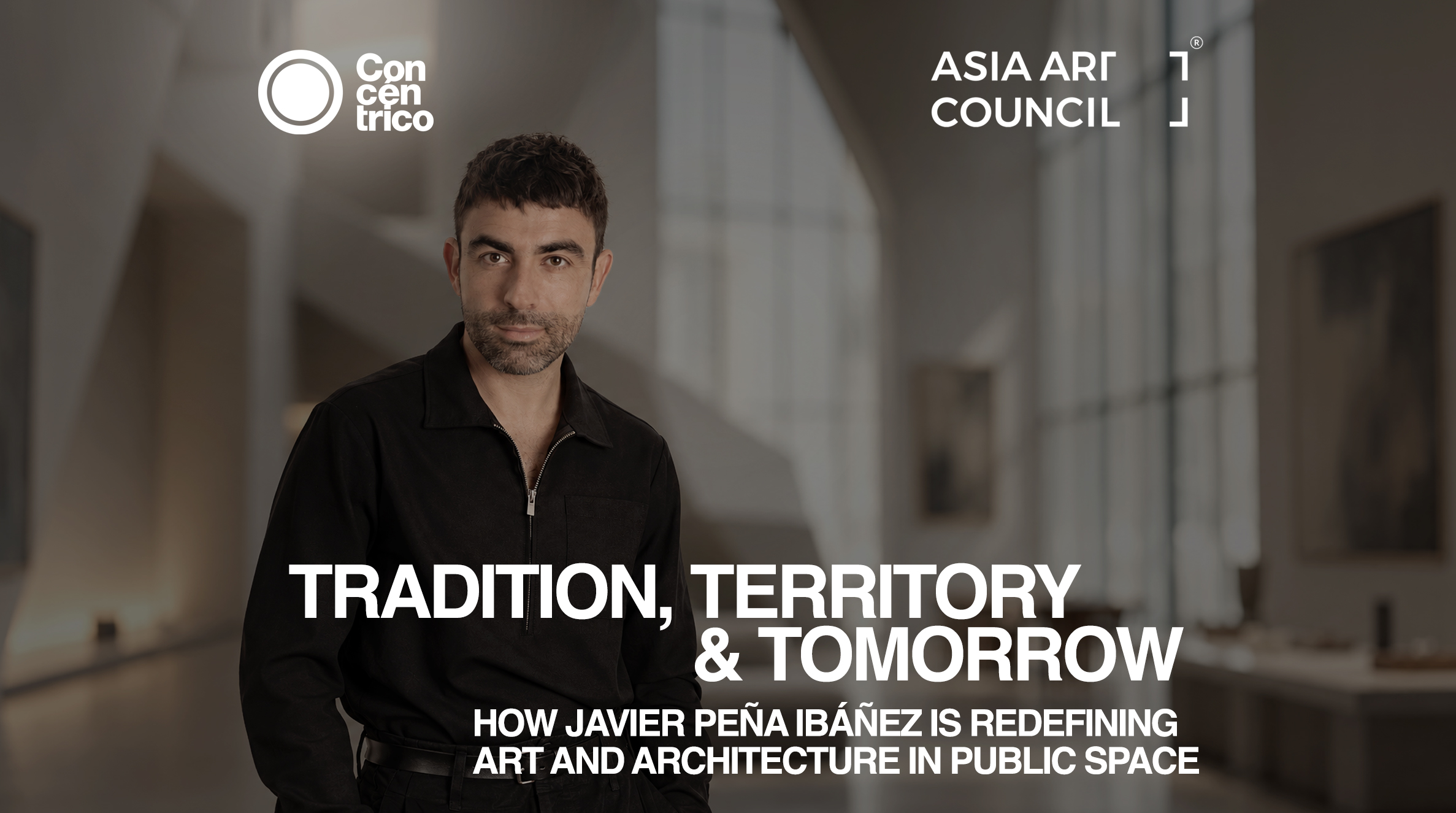
In this compelling interview, the Asia Art Council sits down with architect, curator, and educator Javier Peña Ibáñez. Best known as the founder of the international architecture and design festival Concéntrico in Logroño, Ibáñez shares his vision on bridging the gap between fleeting cultural events and permanent community ecosystems.
AAC: To kick things off, could you share a bit about your background? What do you focus on professionally, and what part of your current work excites you the most?
Javier: I’m an architect, curator and educator, and for the last twelve years my work has focused on how architecture and design can create new relationships between people and public space. I founded Concéntrico in Logroño as a platform to test these ideas directly in the city. What started as a festival has gradually become a laboratory where architects, designers and communities can experiment at full scale, using temporary interventions to question how we inhabit shared spaces. At the moment, I’m particularly interested in taking these processes beyond the format of the festival: longer research periods, new models of commissioning and collaborations between designers, institutions, manufacturers and local communities. This is also central to my work as curator of the Public Design Commissions for Design Doha 2026.
AAC: Thinking about the art and design scene across Asia today, how would you describe its overall vibe and momentum? What changes have you observed over the past few years?
Javier: I would be careful about speaking of Asia as a single cultural scene. The contexts are enormously different, and that diversity is precisely what makes the current moment so interesting. My connection with the region has developed through different experiences over time. In 2017, Singapore-based DP Architects won one of Concéntrico’s open calls and came to Logroño to build a pavilion for the festival’s third edition. More recently, my work has brought me closer to the MENASA region through Design Doha. These are very different contexts, but they have allowed me to engage with practices and ways of thinking that emerge from very different cultural and geographical conditions. What I see today is a growing confidence in local knowledge, materials, crafts and forms of production. There is less need to reproduce models coming from elsewhere and much more interest in understanding what contemporary practice can become when it starts from a specific climate, culture or territory. What interests me most is this movement between very old forms of knowledge and very contemporary questions. It creates possibilities that are not simply about preserving tradition, but about activating it in new ways.
AAC: As cultural fields grow and speed up, what do you feel are some of the biggest obstacles?
Javier: One of the biggest challenges is the difference between visibility and continuity. It is possible to create an exhibition, an event or a spectacular moment relatively quickly. Building an ecosystem takes much longer. For me, the question is how we create conditions that allow practitioners to research, experiment, fail, produce and continue working afterwards. That means thinking not only about the final object or exhibition, but about education, production networks, fabrication, documentation, fair remuneration and what happens to a project after it has been presented. Cultural investment becomes much more meaningful when it creates knowledge and relationships that remain after the event itself disappears.
AAC: If you had the power to introduce a few practical changes to make art and design more accessible, financially stable, and sustainable, what would you do?
Javier: I would invest more in process. That means giving people enough time to develop ideas, paying properly for research and design, supporting prototypes and experimentation, and creating stronger connections between cultural institutions and local systems of production. I would also create more opportunities to work in public space. Museums and galleries are essential, but culture should also be encountered in streets, parks, markets, schools and everyday environments. And finally, I think we need to think much more carefully about the afterlife of what we produce: how a material can be reused, how an installation can move somewhere else, or how the knowledge created by one project can become useful to another community.
AAC: What part do collectors, advisors, galleries, and institutions play in helping a creative community thrive?
Javier: Everyone has a different role, but I think the important shift is from thinking about culture only as something we consume to understanding that we are collectively responsible for the conditions in which it is produced. At Concéntrico we are increasingly interested in projects that can move between public space, design and art, and that can have a life beyond the moment in which they are first presented. Dancing Bench by Soft Baroque is one example: a piece conceived for public space that can later enter other cultural, institutional or exhibition contexts. We are also exploring this possibility with the work developed with AAU Anastas, the Palestinian practice based in Bethlehem. The project was conceived for Concéntrico, but from the beginning we have been interested in its capacity to travel and be activated in different places. For me, this opens up an interesting territory: the festival can be a place where a work is produced and first experienced, rather than necessarily the place where its life ends. This is where institutions, galleries, collections and other cultural partners can become very relevant. They can help projects circulate, find new contexts and create a longer continuity for work that begins in the public realm. I’m interested in developing these relationships further, without losing the experimental and public character from which the projects originate. For me, the strongest cultural ecosystems are those where many different actors understand that they are part of the same network.
AAC: In what ways are younger generations approaching art and design differently compared to before?
Javier: What I find interesting is that younger generations often seem less interested in strict disciplinary boundaries. Architecture, art, fashion, music, digital culture and activism can coexist very naturally within the same practice. There is also a different relationship with institutions. People can build audiences and communities independently, but at the same time they are asking institutions to become more open, responsive and connected to contemporary social questions. For me this is positive. It forces all of us to reconsider what a cultural institution is for, who it represents and how people can participate in it rather than simply visit it.
AAC: The creative world can move at a dizzying and unpredictable pace. What keeps you anchored, and where do you find your inspiration when you need to recharge?
Javier: I spend a lot of time travelling and moving between projects, so what brings me back to things is often very simple: walking through a city and observing how people actually use it. I’m interested in things that were not necessarily designed to be “design”: a temporary shade structure, a market stall, a bench that has been moved, a celebration occupying a street, or the way someone adapts a space to make it more comfortable.
Leave a Reply