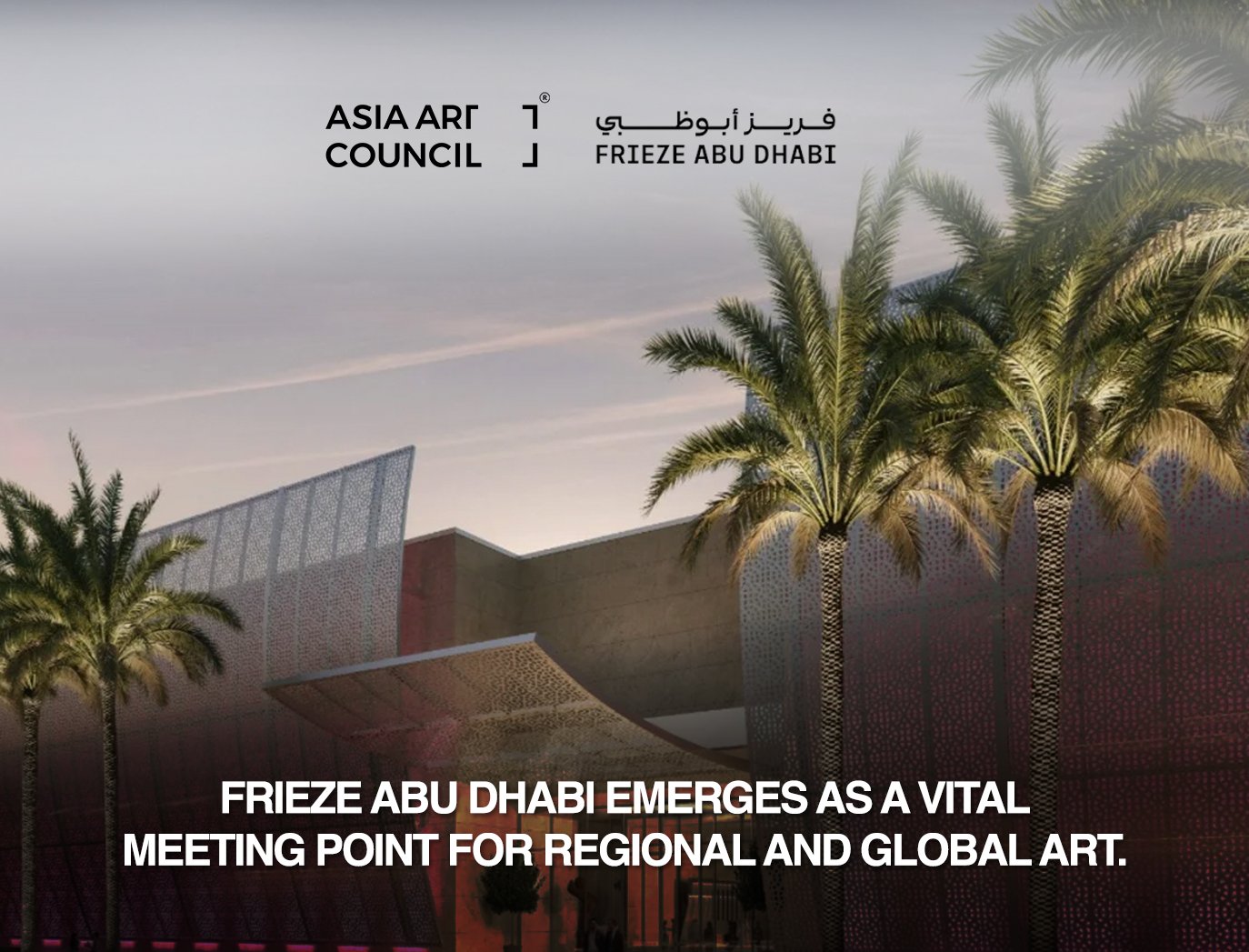
Walking through Manarat Al Saadiyat as the inaugural edition of Frieze Abu Dhabi opens on November 19, 2026, you do not get the sense of a brand-new machine being switched on for the first time. You feel something older and steadier underneath—seventeen years of patient groundwork laid by Abu Dhabi Art and the Department of Culture and Tourism – Abu Dhabi, now stepping into a wider international frame. When Sheikh Khaled opens the doors at Manarat Al Saadiyat ahead of public days running through November 22, the atmosphere has the charge of an opening night that everyone in the art world has been quietly circling for months, heightened by how tightly the fair sits alongside Saadiyat Island’s expanding cultural district and its talks programme.
Fair Director Dyala Nusseibeh, who guided Abu Dhabi Art for a decade before taking the reins of Frieze Abu Dhabi, has spoken of this moment not as a takeover, but as a wedding—a teenager growing up and inviting family and friends to celebrate. Standing amid 89 exhibitors from 37 countries and regions, that image feels remarkably earned. Rather than wiping away what came before, the fair stitches together longstanding regional galleries, established modernists, and major international dealers who recognize that while traditional Western art markets have felt hesitant and uneven, serious institutional weight, patronage, and curiosity across the Gulf and the wider West Asia, North Africa, and South Asia corridor keep compounding.
What makes the room feel genuinely alive to someone who has spent years tracing art-fair circuits is how fiercely the programming resists flat geography. Instead of treating the region as an isolated market or a backdrop for glossy trophies, the fair keeps pulling attention back to the Indian Ocean—that vast, ancient highway of monsoon winds, spice trade, migration, and shared craft linking West Asia, East Africa, and South Asia long before modern borders hardened. Looking at that maritime web from Abu Dhabi changes the conversation from center-versus-periphery to one of overlapping histories, shared trade routes, and ongoing exchange.
You see that thread woven across the fair’s architecture. In Frieze Masters Abu Dhabi, rare books, manuscripts, maps, and historical artifacts trace how ideas traveled across centuries, anchored by Portrait L, a first-century painted portrait returning to the Middle East for the first time since leaving Egypt in 1888. Just steps away in Global Futures, curated by Tarini Malik, eight solo presentations turn that historical lens straight toward the fracture, turbulence, and urgency of right now—from Abdullah Al Saadi shaping an alphabet out of sweet potatoes to Ala Younis’s architectural mosaics and Mohammed Joha’s cardboard-and-textile works carrying the weight of lived displacement and survival.
Even outside the main halls, the fair refuses to stay boxed inside white walls. Dala Nasser’s site-specific commission as the inaugural Frieze Abu Dhabi Artist Award recipient probes land, ecological fragility, and lingering history, while Frieze Sculpture Abu Dhabi stretches outdoor works along Mamsha Beach from November 16 to December 16, letting sea air and everyday foot traffic mingle with monumental form. For visitors moving between coastal paths, museum institutions, and booth aisles, the fair feels woven into the physical rhythm of the island rather than sealed off inside a convention hall.
In any debut fair, you watch closely to see who came to listen and who merely sent leftover stock. Here, the most resonant encounters happen in front of works built over years of slow devotion—whether Sudanese modernist Ibrahim El-Salahi’s tree forms, Hamra Abbas’s pietra dura, or Wardha Shabbir’s intimate landscapes. As Nusseibeh has reminded visitors, opening week is a beginning rather than a final judgment; the real measure will be whether emerging regional spaces and artists gain sustained international momentum long after the crates are packed. If Frieze Abu Dhabi holds onto this curiosity and regional depth, Saadiyat Island will do more than add a line to the international calendar—it will help redraw how the art world sees itself.
Leave a Reply