“An art fair at its best is not merely a marketplace; it is a temporary museum where centuries of inherited memory collide with the urgency of the present.”
MUMBAI — Over four days from November 12 to 15, 2026, the historic grounds of Mumbai’s Mahalaxmi Racecourse transformed into the gravitational centre of the South Asian art world. Returning for its fourth milestone edition, Art Mumbai has decisively matured from a promising regional showcase into an indispensable international cultural institution.
Bringing together 94 exhibitors comprising 73 Indian galleries and 21 international heavyweights alongside major foundations and museums, the 2026 edition demonstrated that South Asia’s financial capital is now equally a formidable nexus for art-historical reclamation, cross-border diplomacy, and contemporary market momentum.
Monumental Scale Meets Architectural Ambition
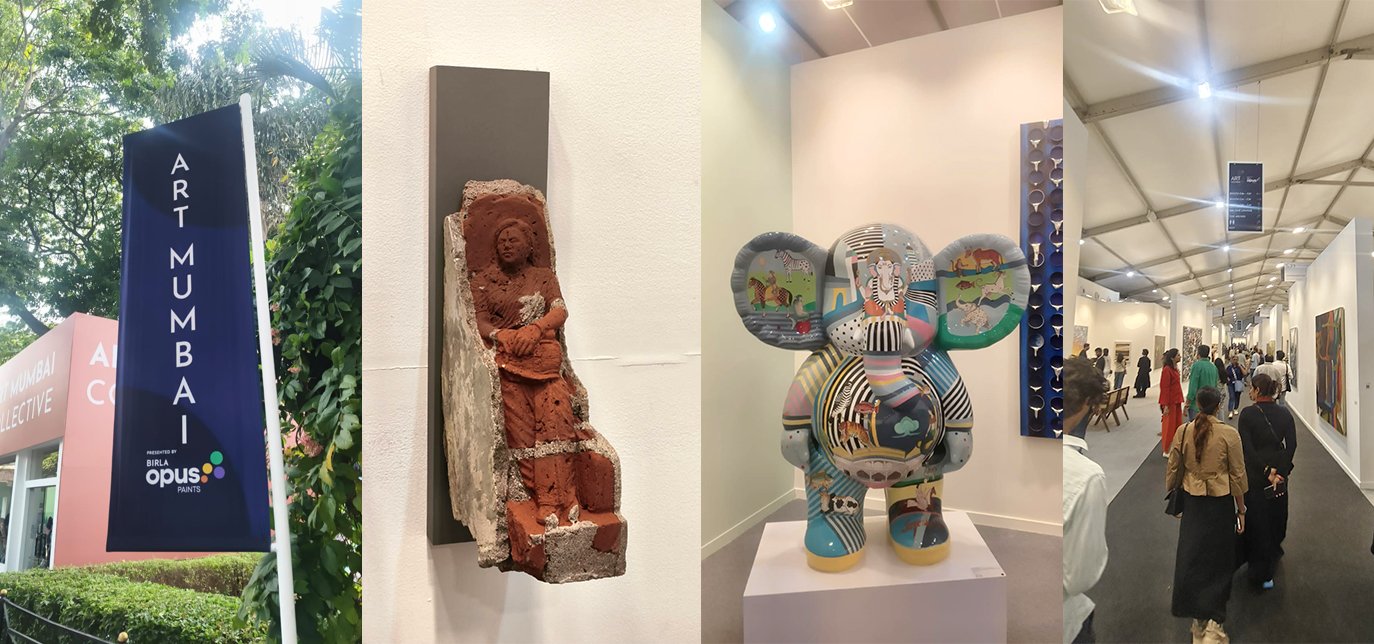
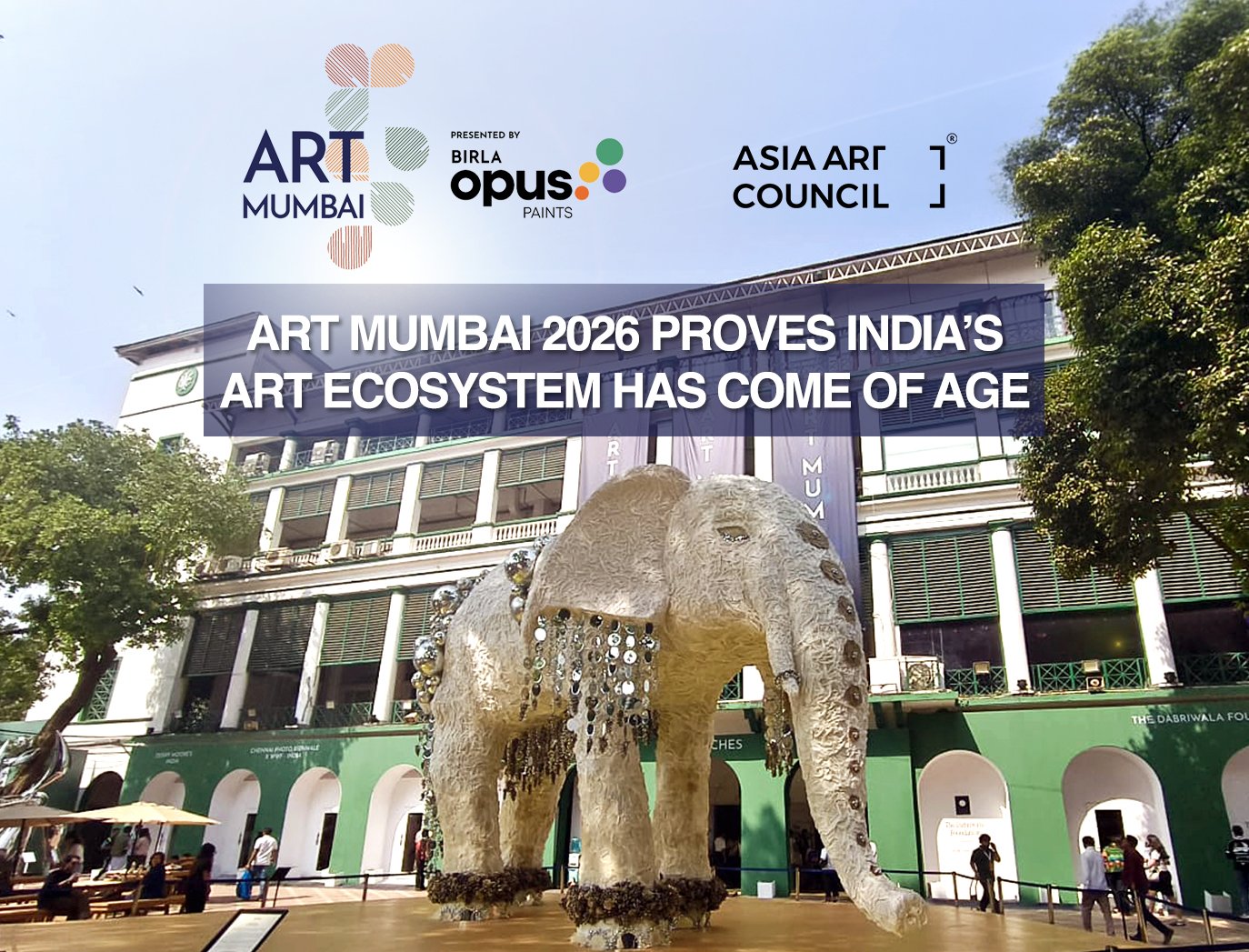
The physical and conceptual grandeur of Art Mumbai 2026 announces itself before visitors even enter the main exhibition halls. Towering at the entrance is Rani, a 20-foot sculptural elephant adorned with intricate hand-detailed mirror work, gota embellishments, and glittering disco balls. Marking the Art Mumbai debut of couturiers Abu Jani and Sandeep Khosla’s art and design vertical, A Wonder Room, the installation pays tribute to Mumbai’s historic Rani Baug zoo—once a sanctuary for rescued elephants—while channeling the maximalist glamour of 1980s Bollywood disco, which came alive on opening night through their Disco Inferno presentation.
Beyond the threshold, the fair’s spatial ambition unfolded across two defining pillars:
- The Outdoor Sculpture Park: Curated around the theme Material and Memory, this open-air showcase brought together 13 monumental installations examining how raw materials from clay, terracotta, and burnt wood to metal and found objects, absorb human and geographic history.
- Landmark International Debuts: Underscoring the fair’s rising stature on the global calendar, major international galleries including Perrotin, Richard Saltoun Gallery, Night Gallery, Niru Ratnam, and Rizq Art Gallery made their Indian fair debuts, exhibiting alongside returning global titans such as Lisson Gallery and Galleria Continua.
Curatorial Rigor and Cross-Border Dialogues
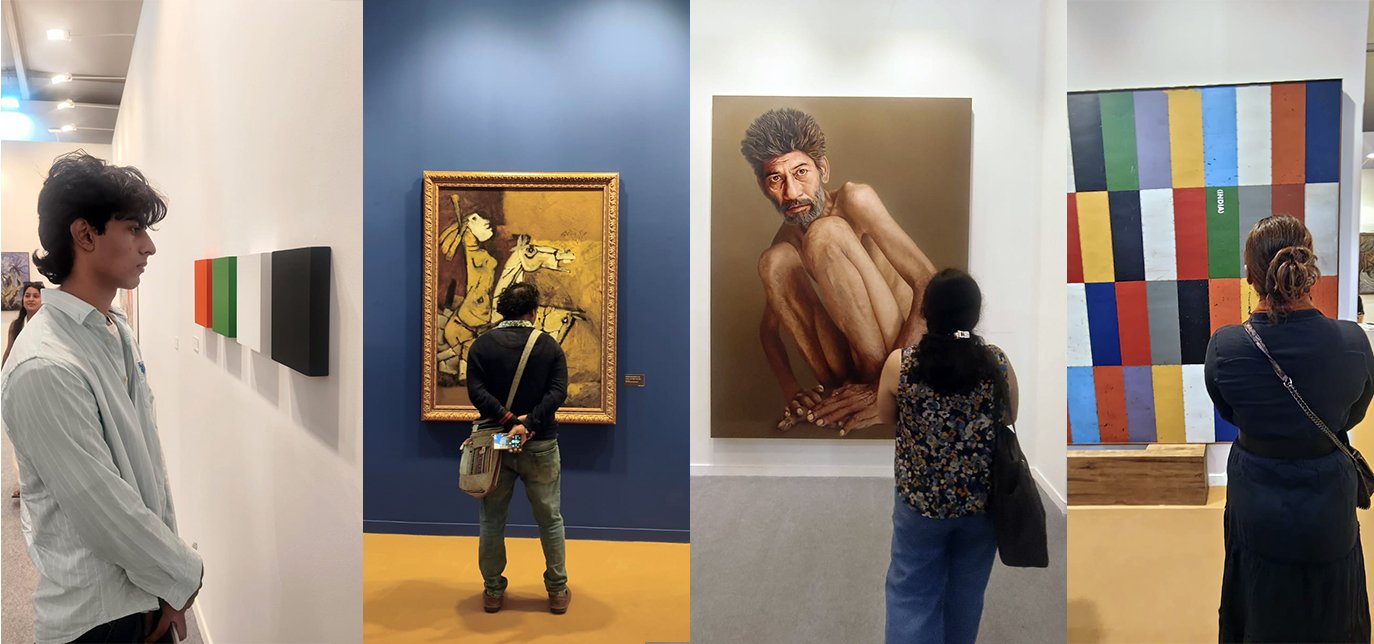
What separates a truly consequential art fair from a mere commercial marketplace is the depth of its curatorial propositions. Across the booths, galleries and foundations placed historical memory in direct dialogue with contemporary urgency.
Reclaiming Subcontinental Histories At Booth A02, DAG’s Visions Across Time offered a sweeping art-historical survey spanning the 18th to the 21st centuries. By juxtaposing 18th- and 19th-century European depictions of Mahabalipuram (by Thomas Daniell and Edward Lear) with Murshidabad Company School watercolours and early academic portraiture by M. V. Dhurandhar and S. L. Haldankar, the presentation traced India’s journey from an object of the colonial gaze to an autonomous site of modernist material experimentation by Jeram Patel, Dhanraj Bhagat, and Satish Gujral. A standout highlight of the booth—and the fair—was the rare return to India of Pakistani National Treasure artist Allah Bux’s iconic 1920s painting Bharat Mata, a work that seldom travels outside Pakistan and served as a poignant reminder of shared subcontinental heritage.
Maritime Bonds Across the Arabian Sea A defining theme of the 2026 edition was the strengthening cultural corridor between India and the Gulf. Making its fair debut, Abu Dhabi’s Rizq Art Gallery explored Mumbai’s historic role as a maritime trade conduit. Emirati artist Reem Al Mubarak presented teak wood—the timber of traditional dhow ships—carved with a poem her great-grandfather wrote to an Indian hakim he crossed the sea to visit, shown alongside Nujoom Alghanem’s textured seascape Voyage and Ruqqaya Al Hashmi’s henna-infused works, as well as seaport-inspired installations by Indian artists Abdullah PA and Amjum Rizve. Returning for its second year, Dubai’s Gallery Isabelle examined contemporary transnational realities through Mohammed Kazem’s Weekend—depicting migrant workers at rest in shared UAE accommodations—and Ahmedabad-born, UAE-based artist Richi Bhatia’s ceramic inquiries into cross-border food and labour systems. Meanwhile, Dubai’s 1×1 Art Gallery, a fixture since the fair’s 2023 inception, bridged regional and global sensibilities with works ranging from Himmat Shah and Chittrovanu Mazumdar to Rina Banerjee and Aygul Sarsen.
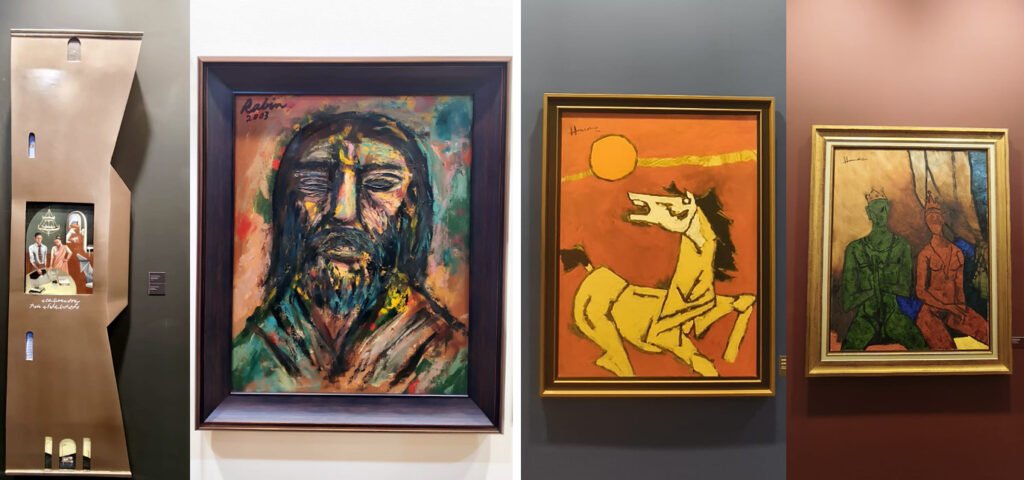
Uncovering Untold Archives and Indigenous Agency Throughout the aisles, institutional and private collections spotlighted overlooked chapters of Indian art and living craft traditions:
- M. F. Husain’s Early Design Vocabulary: Works from the Minal and Dinesh Vazirani collection revealed a lesser-known chapter of M. F. Husain’s career between 1942 and 1949, when he designed custom children’s furniture for the Mumbai company Fantasy—replacing Western nursery rhymes with Panchatantra fables on lotus-shaped armoires and hand-painted closets.
- Poetry and the Urban Fabric: Delhi-based artist Baaraan Ijlal’s When No One Moves—framed within architectural structures by Moonis Ijlal and interspersed with Urdu couplets by Javed Akhtar—constructed a miniature cityscape peering into the hidden lives of the workers who build and sustain urban India.
- Women and Vernacular Traditions: Presented by the Kiran Nadar Museum of Art (KNMA) in collaboration with Saffronart Foundation, Voices from the Earth: Women, Nature, Power (curated by Dr. Preeti Bahadur Ramaswami) traced how women practitioners across Madhubani, Gond, Warli, Bhil, Rajwar, and Patachitra traditions have transitioned ritual wall art onto paper and canvas. Nearby, Ojas Art spotlighted Padma Shri awardee Pandi Ram Mandavi’s Stories Retold, preserving the oral histories of Bastar’s Muria community through intricate hand-carved wooden pillars.
Engaged Crowds and Civic Participation
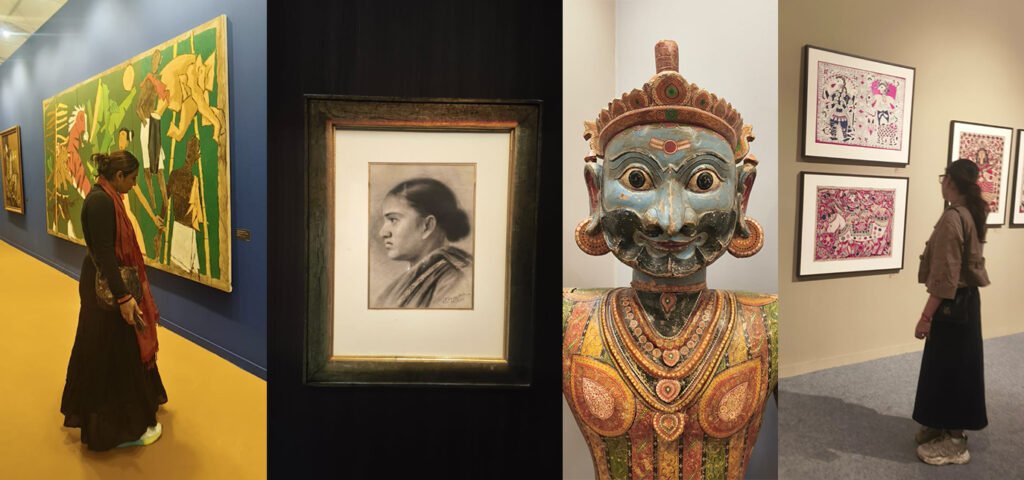
If the quality of the art set the standard, it was the calibre of the audience that defined the atmosphere on the ground. From the opening previews through the weekend, the pavilions were packed with visitors engaging deeply with the works. As Gallery Isabelle director Jad Karam observed, Indian collectors stood out as remarkably “curious, knowledgeable, and enthusiastic,” taking the time to research artistic practices and ask probing questions rather than merely acquiring familiar names.
That intellectual seriousness powered strong commercial momentum alongside broad public participation. Resisting the insularity that often characterizes major fairs, Art Mumbai 2026 anchored itself as a genuine civic forum through 14 panels in its Speaker Series featuring voices from Javed Akhtar and Ranjit Hoskote to Louvre Abu Dhabi director Manuel Rabaté and museum leaders across Asia—alongside guided walks, hands-on workshops, and live performances.
As the fourth edition concludes, one reality is unmistakable: the Asian art market has entered a truly multi-polar era, and Art Mumbai stands firmly at its centre. By uniting historical scholarship, indigenous craft, cross-border Gulf-Indian dialogue, and international blue-chip rigor under one roof, the fair has proven that Mumbai is no longer simply an emerging stop on the global art circuit, it is one of Asia’s most vital cultural capitals.
Leave a Reply