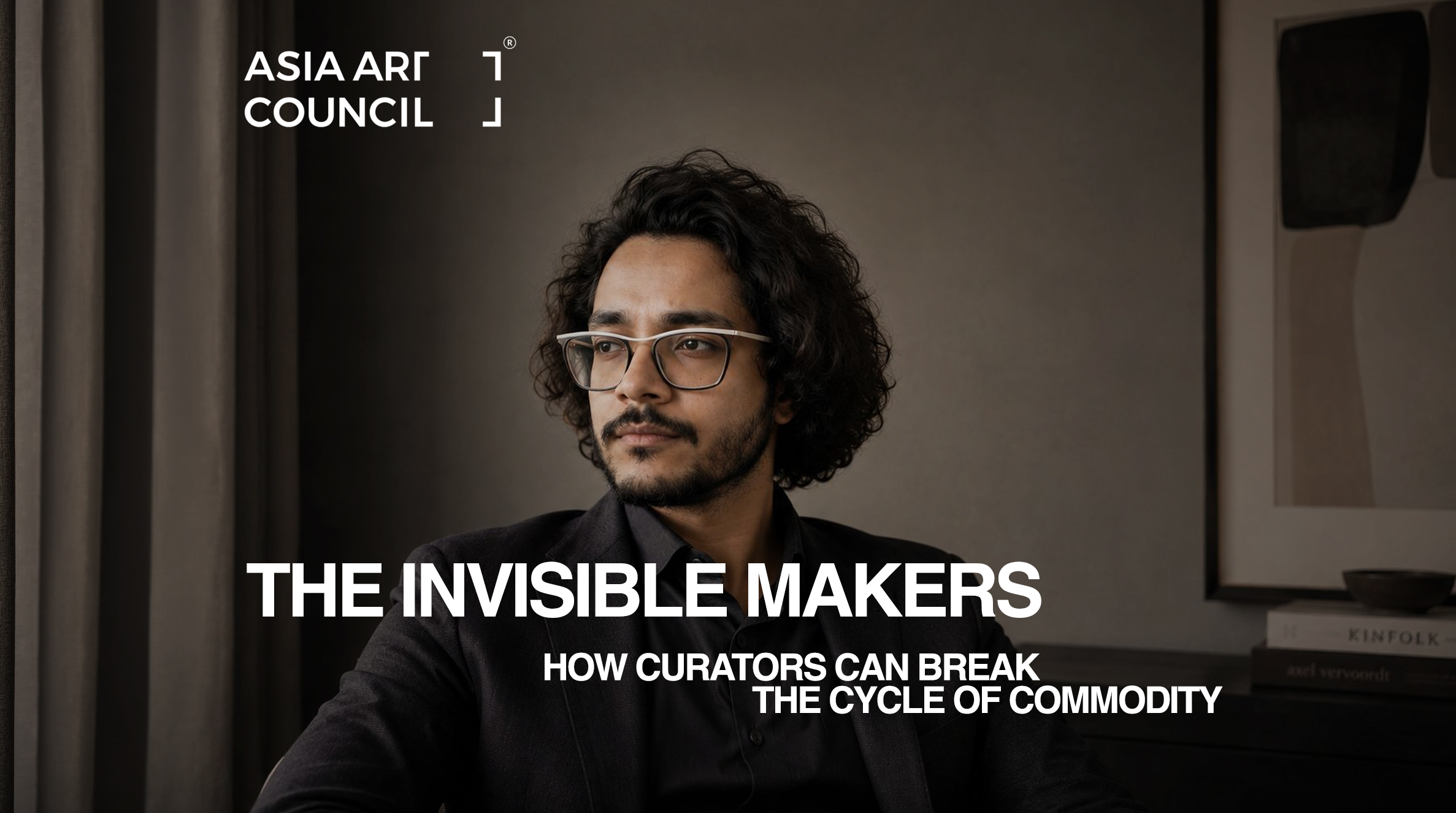
Asia Art Council speaks with Adib Rizvi, an independent curator and researcher. Drawing on his early grounding in artisan traditions and his extensive work across museum and contemporary spaces, Adib discusses the evolving Asian art landscape, the importance of moving beyond established networks, and how contemporary curatorial practice can honour living craft traditions without reducing them to mere commodities.
AAC: Adib, your journey into the art world started long before your professional career, rooted in an early fascination with makers and how things are made. How did those early encounters shape your path into curating, and what core questions continue to drive your practice today?
My engagement with art began much earlier than my professional life, through an early familiarity with artisans and the processes through which objects are made. What stayed with me was not simply the finished object, but the questions around it; why a particular technique exists, how knowledge passes from one person to another, and why certain forms of making become culturally valued while the people behind them remain largely invisible. That way of looking became more conscious through my studies and later through museums, where I began to understand how objects are framed, interpreted and assigned meaning. Curating emerged from that questioning rather naturally.
My encounters with museums, galleries and contemporary art spaces expanded those questions further. I became interested in how an artwork changes when its context changes, and how curatorial decisions influence what we see and understand. Reading practitioners such as Hans Ulrich Obrist, Harald Szeemann and Amin Jaffer were important in developing that perspective. Much of my thinking now returns to that original impulse to look more closely; at artists and makers, at the systems around them, and at what remains outside established narratives.
AAC: The contemporary art landscape across Asia has exploded with new spaces, cross-border collaborations, and diverse audiences. From your vantage point, how do you see this dynamic momentum shifting, and what lies ahead as new creative hubs emerge?
There is a lot more movement in the Asian art world today. We are seeing new institutions, fairs, independent spaces, cross-border collaborations and a much wider range of audiences engaging with art. Art is also moving beyond the traditional gallery and museum setting into design, hospitality, digital platforms and other cultural spaces. That has created an energy that feels much more dispersed than it was before.
What I find interesting, though, is that greater visibility does not automatically mean greater diversity. The same established networks can still determine who gets seen, who gets represented and who gets access to larger platforms. At the same time, there are artists and independent initiatives emerging from places that have historically received less attention. I think the next interesting phase for Asia will be about how those different centres begin to connect with one another, rather than everything continuing to move through a handful of established gateways.
AAC: While Asia boasts incredible institutions, archives, and residencies, barriers to entry often persist. In your view, what are the primary structural bottlenecks holding parts of the ecosystem back, and how can we create more open pathways?
I think one of the more significant challenges is not necessarily the absence of infrastructure, but the way access and visibility operate within the infrastructure that already exists. There are excellent institutions, researchers, galleries, archives, residencies and independent initiatives across Asia, but access to these spaces can still be uneven. Certain networks have accumulated considerable cultural capital over time, and that can influence whose work enters larger conversations, who gets opportunities and which practices become part of the established discourse. The question, therefore, is not simply whether opportunities exist, but how open the pathways into those opportunities really are.
I think we need to make those pathways more permeable. Greater transparency around commissions, exhibitions, residencies and collaborations can help, but so can a willingness to look beyond familiar networks when developing programmes and partnerships. There is also a need to recognise that artistic value does not emerge only from established validation; it can come from practices that have not yet had the opportunity to enter those circuits. For me, strengthening the ecosystem means creating more points of entry into it, so that talent, ideas and serious practices are not limited by how well connected someone already happens to be.
AAC: If you could wave a magic wand to structurally reshape the industry, what bold changes would you implement to make the art world genuinely accessible, sustainable, and fair for emerging contributors?
I would make the art world more permeable. We often discuss making art accessible to audiences, but there is another question: how accessible is the ecosystem to those who want to contribute to it? Strong ideas, research or curatorial proposals can sometimes struggle to find a pathway simply because they exist outside established networks. Relationships will always matter in the art world, but they should not become the primary condition for participation.
I would therefore push for more transparent opportunities, stronger support for emerging practitioners and fairer remuneration across the sector. I would also create more room for experimentation without an immediate commercial expectation. An ecosystem becomes sustainable when people are not only able to enter it, but are given enough space and support to develop meaningful practices within it.
AAC: Across India and the broader region, living traditions of craft run deep. How can curators engage with these rich techniques and histories today without falling into the trap of packaging them as mere heritage objects or aesthetic commodities?
I think the important thing is to recognise craft as a living practice rather than something simply inherited from the past. Practitioners continue to adapt techniques, materials and ways of working in response to changing circumstances. The problem is that we can sometimes become more interested in the aesthetic of a craft than in the knowledge and people behind it, extracting a visual language while the maker’s context and agency recede.
A more meaningful engagement has to begin with the practitioner. Their knowledge, decisions and contemporary realities should shape how the practice is presented, rather than being added afterwards as context. If these practices enter museums or contemporary spaces, the makers should not simply become subjects of interpretation; they should have a voice in how their knowledge and work are understood.
AAC: With the traditional lines blurring between museums, commercial galleries, and lifestyle spaces, how has the role of the curator evolved, and how do you balance commercial partnerships with curatorial integrity?
I think the curator increasingly has to be comfortable moving between different worlds. The same project might involve an artist, a museum, a private collection, a commercial partner and an audience that has very little previous engagement with contemporary art. Each brings a different expectation, and the curator has to negotiate between them without losing sight of the work itself.
For me, that means creating the right relationships rather than simply putting works together. Why these artists? Why this context? Why now? Those questions become important because the way something is framed can substantially change how it is understood.
I don’t think working with commercial spaces is necessarily opposed to good curatorial practice. In fact, commercial and private platforms can sometimes provide resources and opportunities that institutions cannot. What matters is maintaining enough independence to ensure that the work is not reduced to whatever happens to be easiest to sell, communicate or consume.
AAC: Younger collectors and audiences are increasingly discovering art through social media, independent online spaces, and cross-disciplinary collaborations. How is this decentralized discovery altering the way people perceive artistic and financial value?
Definitely. Traditional structures; auction houses, established galleries and major collectors; still have considerable influence, particularly in how market value is established. But discovery has become much more dispersed. Someone might encounter an artist through Instagram, a design collaboration, an independent exhibition or an online conversation long before entering a conventional gallery or auction setting.
That has also complicated the idea of value. Market price, popularity, cultural relevance and artistic significance do not necessarily coincide. Younger audiences seem more willing to engage with those different forms of value simultaneously, developing a relationship with an artist or practice before considering its financial dimension. I think that shift is important because it allows artistic value to be discussed beyond price alone.
AAC: The fast-paced cycle of global fairs, biennials, and exhibitions can be relentless. What helps you stay grounded, and where do you look to find slowness and inspiration when you need to recharge?
I think what keeps me grounded is stepping outside the pace of the art world itself. Spending time with objects, visiting museums, travelling, looking at architecture, or simply speaking with artists and makers often gives me more perspective than following the constant cycle of exhibitions, fairs and auctions. I am also drawn to practices that develop slowly; an artist working through an idea over years, or an artisan developing an intimate understanding of a material over decades.
More than anything, I think curiosity keeps me engaged. It is easy to become absorbed in the language and rhythms of the art world, but remaining curious about people, materials, histories and different ways of seeing keeps that distance. Sometimes stepping away is simply a way of returning to work with a less predetermined way of looking.
Leave a Reply