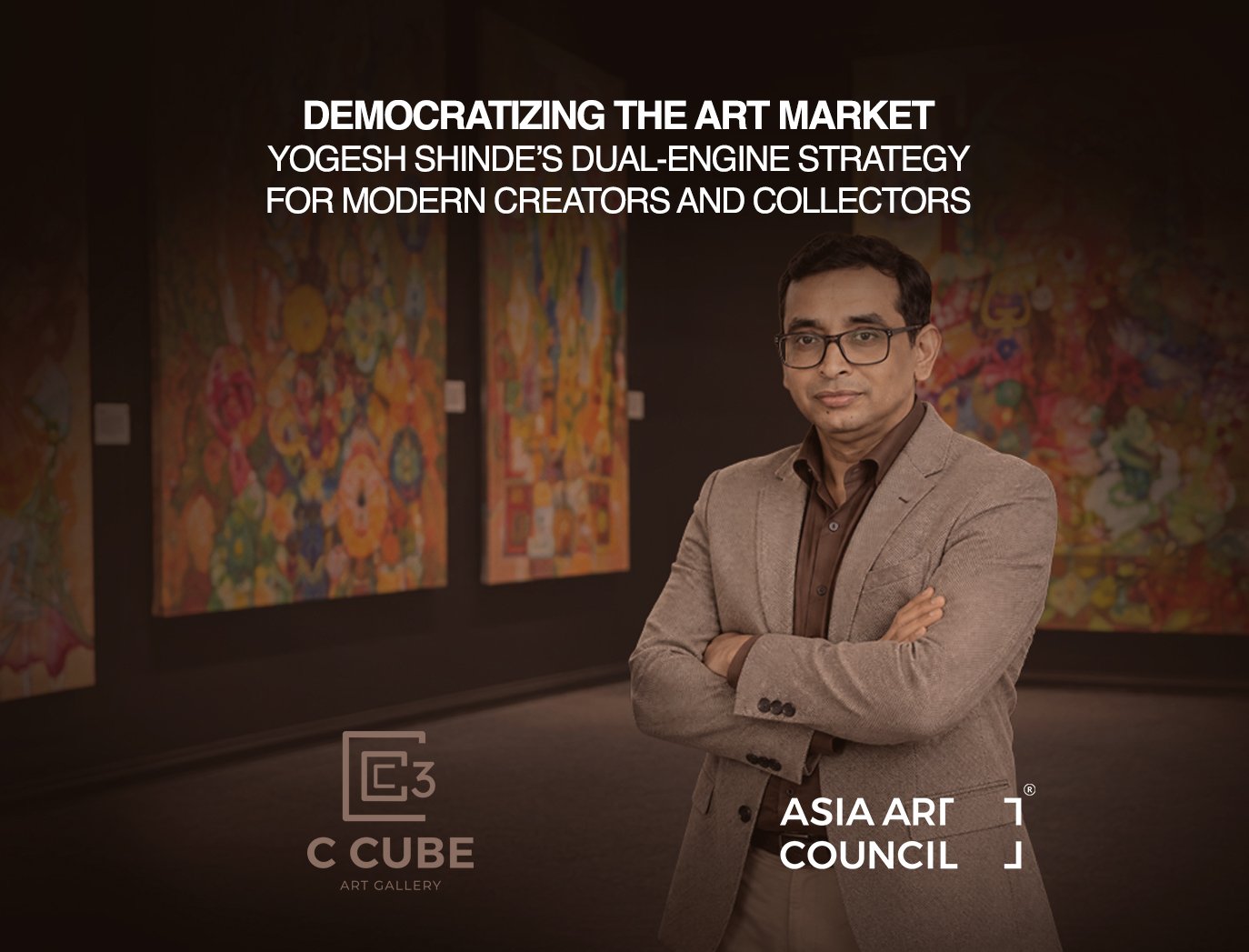
AAC: Beyond your roots in connecting traditional heritage to modern markets, what core expertise defines your journey, and what project has you most energized at this exact moment?
Yogesh: I am Yogesh Shinde, founder and Director C Cube and Rangkunchala Art Gallery With nearly 13 years in the art domain, my journey has been built on connecting traditional artistic heritage with modern market ecosystems. Rangkunchala Arts was founded with a clear motif: to empower and uplift Rural and potential artists by building an ecosystem that incubates creative talent and secures sustainable financial futures.
To achieve this, we developed a dual-engine architecture:
- Rangkunchala Arts: Serves as an incubator for grassroots and rural artists. We create continuous revenue streams for artists through licensed prints, digital platforms, and B2B decor solutions (RK Décor).
- C Cube (Curate. Collaborate. Create Value): Acts as our premium art investment division. C Cube focuses on high-value, contemporary, progressive, and meditative art, serving high-net-worth collectors and international art investors.
What excites me most right now is our upcoming launch of an accessible Art Auction & Bidding Platform combined with asset tokenization, bridging traditional art investment with tech-driven accessibility.
AAC: If you had to take the pulse of Asia’s current art and design landscape, how would you characterize its momentum, and what major paradigm shifts have caught your eye over recent years?
Yogesh: The Asian art ecosystem is undergoing a massive shift from passive appreciation to active asset integration and technological adoption. Art is no longer viewed merely as wall décor; it is recognized as a legitimate alternative asset class with steady yield potential.
We are observing three major movements:
- Early Integration in Spatial Design: Architects and interior designers are integrating art into early project rendering phases rather than treating it as an afterthought.
- Democratization through Licensing: The growth of licensed art prints allows creators to gain recurring royalty revenue beyond single gallery sales.
- Portfolio Diversification: High-net-worth buyers are focusing on structured investment categories like Meditative Wealth, Progressive Art Movement, and Contemporary masterworks.
AAC: From where you stand, what structural roadblocks are currently stifling the Asian art ecosystem, and what blueprint do we need to dismantle them?
Yogesh: The primary challenge in the Asian art market is the high barrier to entry and the dominance of a few institutional players. For instance, the Indian auction ecosystem is concentrated around just few major traditional auction houses, creating a significant market gap for low-to-mid ticket size artworks.
To solve this, we need to address two structural bottlenecks:
- Financial Sustainability for Grassroots Artists: Traditional models leave artists waiting for sporadic gallery sales.
We address this through licensing programs and digital asset platforms, providing steady, recurring royalty income from stock platforms, interior projects, and merchandise. - High Liquidity Thresholds for Collectors: By introducing lower entry prices, accessible digital bidding platforms, and asset tokenization, we can make art investing transparent and liquid for broader audiences.
AAC: If you could instantly redesign the art rulebook, what bold strategies would you implement to secure long-term financial viability and accessibility for creators and collectors alike?
Yogesh: We need to treat art both as a sustainable micro-economy for creators and as a multi-tier asset class for investors.
- B2B Integration at the Blueprint Stage: Through RK Décor, we partner with architects and interior designers during the 3D rendering stage to deliver end-to-end solutions from spatial concept to final physical installation.
- Hybrid Revenue Platforms for Artists: Artists should earn from multiple streams, direct sales of original artworks, ongoing print licensing royalties, and digital asset usage.
- Structured Art Portfolios: Investors need institutional-grade asset classification. At C Cube, we curate works across three strategic pillars: Meditative Wealth, Progressive Art Movement, and Contemporary Masters.
AAC: How must every stakeholder across the value chain from galleries and institutions to advisors and collectors, step up to actively cultivate a thriving Asian art community?
Yogesh: Building a sustainable ecosystem requires collaboration across the value chain:
- Galleries & Platforms: Must act as incubators rather than gatekeepers. Rangkunchala provides rural and emerging artists with platform access, technology tools, and commercial channels.
- Designers & Architects: Can bridge the gap between commercial construction and fine art by incorporating art budgets early into project blueprints.
- Investors & Collectors: Should balance legacy acquisitions with supporting mid-tier and emerging creators, helping expand the entire ecosystem.
AAC: In what ways are digital-native Gen Z investors and emerging buyers completely rewriting the playbook compared to traditional collectors?
Yogesh: Younger collectors such as Gen Z investors and middle-tier home buyers approach art with a blend of tech affinity, value-driven aesthetics, and investment savvy.
- They prefer dynamic access models over traditional static gallery shows.
- They value provenance, transparency, and digital integration like crypto acceptance and asset tokenization.
- They seek accessible price points that allow them to start building portfolios early in their financial journeys.
AAC: Amidst a fast-moving industry, what personal touchpoints keep you anchored, and where do you draw fresh inspiration when it’s time to recharge?
Yogesh: Working directly with rural artists and witnessing their creative growth keeps me grounded. Seeing a rural artist transition from financial uncertainty to a reliable recurring royalty stream brings clarity to our core mission. My inspiration comes from blending timeless heritage motifs with modern technology to create lasting impact.
AAC: What is next on the horizon for Rangkunchala and C Cube?
Yogesh: We are expanding our ecosystem across two main pillars:
- C Cube Art Auction & Bidding Platform: Designed to democratize high-value art investment by bringing low-to-mid price tier auctions, crypto payment acceptance, and asset tokenization to a global audience.
- RK Décor Expansion: Scaling our B2B design platforms to serve Tier 1, Tier 2, and Tier 3 cities across residential and commercial sectors.
Building a sustainable, tech-enabled art ecosystem takes a community.
We invite mission-aligned venture investors to fuel this vision and passionate artists to join our growing network.
Leave a Reply