
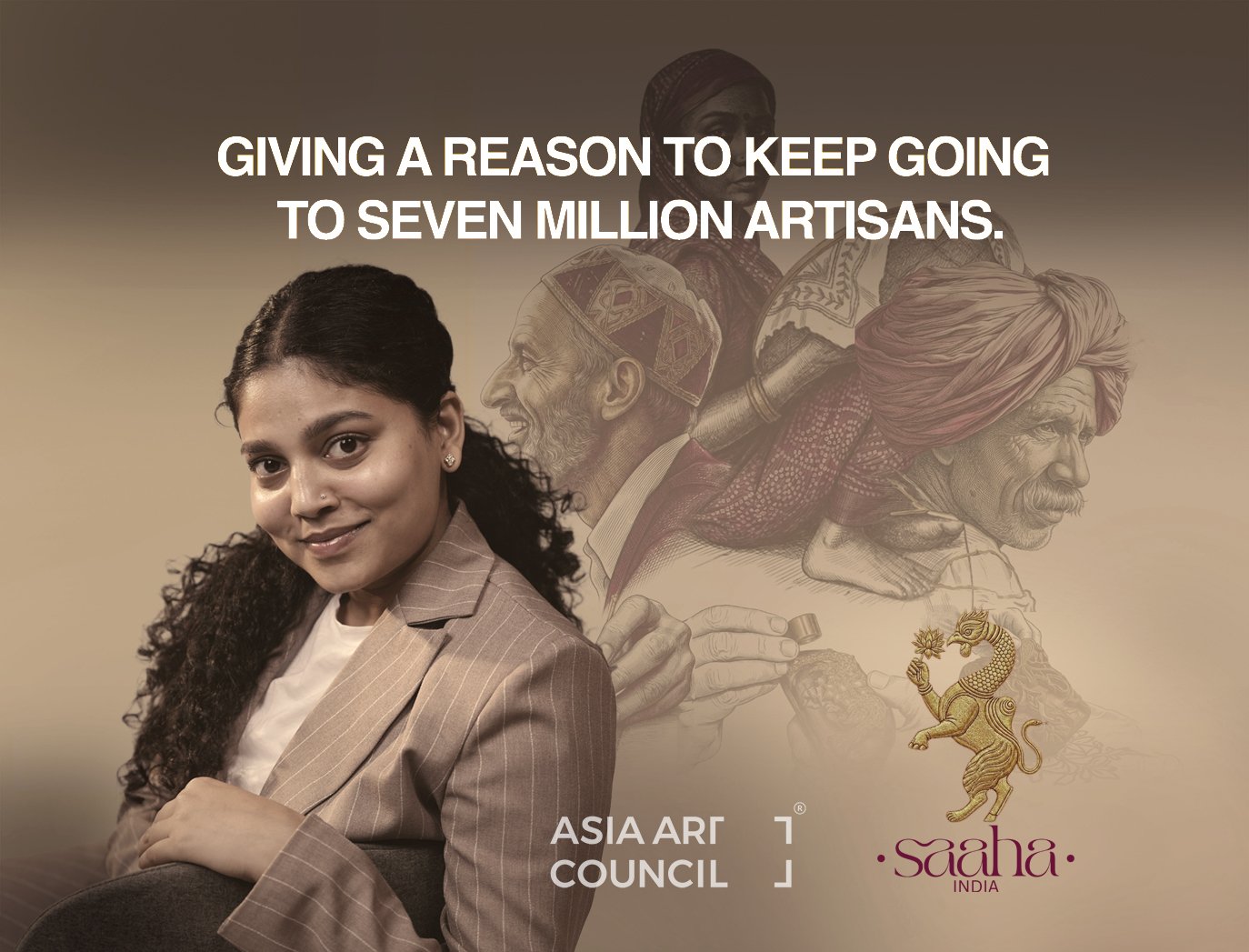
Jaishree Soni is the founder and curator of Saaha India. She grew up between Jaipur, a World Craft City, and Shekhawati, often called the world’s largest open-air art gallery, and the history, culture and art of these places became her earliest teachers. At nineteen, she built the Mall of Shekhawati, a museum of everyday life and an antique store. After that, her path kept changing, publishing a book of poetry, handling public relations for global tech giants, an MBA. Until it all led back to what she loved most: the stories of India.
In this conversation with ASIA ART COUNCIL , she talks about why she built Saaha, what’s really holding India’s art ecosystem back, why so many of its crafts are disappearing, and what the future of the handmade looks like.
AAC: What is Saaha India, and why did you build it?
JS: At Saaha, every piece starts with research. We find a real, specific, underrated story from Indian history, mythology or folklore, and turn it into a limited-edition, handcrafted collectible.
The logic behind it was simple. I kept seeing three problems sitting right next to each other.
India’s stories: five thousand years of civilization, much of it still alive, and so much of it living only in memory. A story without a form disappears the moment nobody is left to tell it.
Indian art: more than 3,000 craft forms, producing extraordinary work. But without context, people see decoration, not meaning.
India’s artisans: about seven million skilled artisans. What they often don’t have is a reason to keep going.
These three problems depend on each other, yet nothing was being built where they meet. Nothing bridged all three. So, I built Saaha. I started it a year ago, and seven drops in, our Collector’s Circle has grown to about 1,200 people across sixteen countries.
Every piece we make is one-part Indian story, one-part Indian art, and one-part the artisan who made it. That’s why we call them artefacts, not artworks and not products.
It still moves me, every single time. When the story of the last camel herder of a ten-generation lineage turns into a walking stick. When the story of a queen who ruled without ever being seen turns into an ittar dan. When the battle tactics of Chhatrapati Shivaji, the Maratha king, turn into a series of ornate daggers. When a Bengali folk tale turns into a sculpted horse’s head. Each time, there’s a quiet ache of satisfaction. That I did my small part. That one more piece of India’s memory won’t be lost.
AAC: How is India’s new generation of collectors different from the one before it, and are they buying for love or for status?
JS: For three generations, collecting art in India was a private act, almost by rule. You protected wealth by not showing it. That instinct runs deep here, shaped by decades of high taxes on visible assets and constant social scrutiny. Even our most serious collectors were called “discreet”: pieces kept inside homes, rarely photographed, rarely discussed outside the family.
The new collector does the opposite. They photograph the piece, post it, tag the maker, and explain to total strangers why they bought it. And let’s be honest about why. Right now, a lot of this buying is about being seen. There’s new money, peers are doing it, and it signals something. But new money doesn’t come with art fluency attached. Plenty of people who can suddenly afford to collect are genuinely intimidated by it, worried about saying the wrong thing. What’s building their confidence isn’t galleries. It’s the internet, creating the demand and the confidence at the same time. So, is it love or status? Mostly status, for now. That’s not the flattering answer people in my industry are supposed to give, but it’s true. And I don’t think it should be ashamed. Almost nobody starts as a purist.
Here’s where I’ll take a position, though: the starting point matters less than people assume. A pure asset never asks anything of you. A piece with a real story attached gets under your skin whether you meant to let it or not. One of our collectors in Vietnam told me that if her plane were ever going down, our artefact would be the one thing she’d care about saving. Nobody says that about a stock certificate.
AAC: What do you feel are the biggest bottlenecks holding India’s art ecosystem back right now?
JS: I’ll answer this for people like me, the small, new houses trying to build something original in this space.
The first is copying. A design an artisan spent months developing can be machine-made and sold for a fraction of the price within weeks. A GI tag protects a region’s name for a craft, not the person who designed the piece. Design registration exists, but very few small makers use it and enforcement is slow and expensive even when they do. The cost is huge: if anyone can copy you for free, nobody invests in new designs, and the industry ends up competing only on price. We’ve had our own work copied. What we’ve learned is that the law won’t protect you fast enough. Provenance will. A copy can replicate the shape. It can’t replicate the artisan’s signature, the certificate, or the story behind it.
The second is getting Indian work out to the world. Our Collector’s Circle has members in sixteen countries, and getting a piece to most of them is still the hard part: paperwork, customs, packing something fragile that took months to make, and costs a small house can barely absorb. Multiply that across the industry and there’s real global demand for Indian work that simply never gets met, because getting it there is harder than making it.
And underneath all of it is money. Work like this is slow by nature, and most capital in India is looking for things that scale fast. Patient money for slow, original work barely exists. That cost is the hardest to see, because it’s everything that never got made: every idea that needed eighteen months and only got six, every small house that shut before its second collection.
They’re economic problems and each of these quietly decides what India gets to make, who gets paid for it, and whether the world ever sees it. Solve them, and you don’t just help a few small houses. You change what India’s making traditions can be worth.
AAC: The art world still ranks a painting above a textile, a perfume or a piece of jewellery. Where does that ranking come from, and does it hold for Indian work?
JS: Let’s start with something most people don’t realize: the line between “fine art” and “craft” isn’t one India ever organized itself around. Our own classical texts list sixty-four Kalas, or arts. Painting and music are on that list. So are perfume-making, jewellery and stringing garlands. They sat side by side, as equals in the same tradition.
That split arrived on a specific ship, for a specific reason, at a specific point in history. When the British arrived, they brought a classification system with them. Oil painting and Western sculpture sat at the top. India’s miniatures, textiles and craft traditions were classified as decorative. Functional. Ethnic. Not art. That hierarchy became the structure of every school, every museum, every auction catalogue that followed. India inherited it at independence, and never fully dismantled it.
So, when a museum files an Indian textile under “decorative arts” today, it isn’t describing the object. It’s repeating a colonial filing decision. I’d ask how much of what we call “craft” in India is simply art that was never allowed to keep the name.
AAC: Many of India’s traditional crafts are disappearing. What do you think is really behind that, and who should be doing something about it?
JS: A craft doesn’t die once. It dies twice: once when the hands stop, and once when the name is forgotten. We are only in the business of stopping the second death.
Every artefact we make comes with a certificate of provenance, with the artisan’s name printed on it and signed by them personally, alongside ours. The first time I handed one to a master craftsman, for a piece he’d spent months on, he held it, read his own name, looked up at me, and asked, very quietly, “Can I sign this?” Not “should I.” Can I. Like he needed permission for something that was already, entirely, his.
I’ve since met a craftsman on the other end of that same feeling: a master of his art who won’t let his own children near his workshop. Not because the craft isn’t extraordinary, but because decades of mastering it never paid rent and never earned him a name. He’d rather the lineage end with him than hand his child the same invisibility.
So, is anonymity part of what’s killing these crafts? I don’t think it’s part of it. I think it’s the mechanism. Patan Patola, a double-ikat weave with GI protection, once had roughly seven hundred practicing families. Today it’s down to three or four, all from one lineage. Kotpad weaving in Odisha is down to eighteen households. Neither craft ran out of skill. They ran out of reasons for a child to stay.
So, who’s responsible? Mostly, everyone currently issuing statements about it. A scheme, an award, a heritage tag: none of them give an artisan more money or a name, and none of them change what a parent decides at the kitchen table about whether their child should apprentice. The responsibility sits with whoever works with artisans.
At Saaha, we pay our artisans thirty percent more than they’d usually earn for the same work, and every piece carries the name of the person who made it. We can see it working. We only ever make a few pieces at a time, the kind of small order most artisans would turn down, and they keep choosing to work with us. Once their name is on the work, you can see the difference in how they carry themselves. That’s what stopping the second death actually looks like.
AAC: Will technology help preserve heritage, or make handmade irrelevant?
JS: Honestly, I don’t think technology is the threat to handmade that people make it out to be. If anything, it might be what finally makes people value it again.
Very soon, almost anything can be made without a human ever touching it. Machines can carve it, printers can build it, software can design it. A pattern, a painting, a perfect replica of a five-hundred-year-old design, in seconds. When making something looks effortless, the only thing that stays scarce is proof that a person made it, with time, skill and their own hands. Technology won’t kill handmade. It will make human effort the luxury.
We made that choice with Baijilal Ittar Dan. We had to give a face to a queen no portrait had ever recorded, and all we had were old written descriptions of how she looked. A machine could have produced a face from those descriptions in seconds. We asked a master miniature artist in Jaipur to paint it by hand instead. A machine would have given us a picture. The artist gave her a face.
What excites me is what technology can do for heritage, and for the people behind it. 3D scanning can save a fading fresco exactly as it looks today. Digital archives can bring back manuscripts in scripts few people can still read. And the internet lets a story from one village find a collector on another continent overnight. But I’m careful not to confuse a record with a living craft. You can film a master’s hands in perfect detail, and the craft will still die if no child has a reason to learn it. Technology can carry a maker’s name further than ever. It can’t replace the maker.
Walk into an old haveli in Shekhawati and you can feel that someone spent years on those walls, one brushstroke at a time.
No screen has ever made me feel that. I don’t think one ever will.
AAC: The art world moves fast and can be unpredictable. What keeps you grounded, and where do you look for inspiration when you need to recharge?
JS: Ramgarh grounds me first, the village in Shekhawati where I built the museum. I can walk the same lane a hundred times and still find something new: a half-erased fresco, an old door left ajar, someone willing to tell me who lived there. Some days I just sit in a courtyard and imagine that life, three hundred years back. Slower. Unhurried.
Food is the other one, and I mean cooking: elbows deep, odd hours, no occasion required. Being Rajasthani, food was never just food growing up, and I’m good at it, especially fusion. It’s the one hour of my week where being wrong doesn’t cost me anything.
And some days, grounding is doing nothing at all: sitting somewhere crowded, completely anonymous, just watching strangers live their small, unrelated lives. No name on me. Nothing needed from me. Just a guest, for once, instead of a founder.
Grounding, I can engineer. Inspiration doesn’t work that way for me. It strikes uninvited, whenever it wants, mid-traffic-jam, and doesn’t care if I’m ready. The one thing I’ll take credit for is this: my job puts me inside a rabbit hole every single day, whether I go looking for one or not. I can’t control when it hits. I’ve just built a life where it gets an unfair number of chances to.
Leave a Reply